
IT Staff Augmentation Services: Complete 2026 Guide
Modern businesses face a persistent challenge: accessing specialized technical talent exactly when needed without the overhead of permanent hires. IT staff augmentation services have emerged as a strategic solution, enabling organizations to scale their technical capabilities rapidly while maintaining operational flexibility. As technology evolves at an unprecedented pace in 2026, companies increasingly turn to augmentation models to fill critical skill gaps, accelerate project timelines, and maintain competitive advantage in their respective markets.
Understanding IT Staff Augmentation Models
Staff augmentation represents a flexible outsourcing strategy where businesses temporarily supplement their existing workforce with external professionals. This approach differs fundamentally from traditional outsourcing or managed services by integrating external talent directly into your in-house teams.
Core Engagement Types
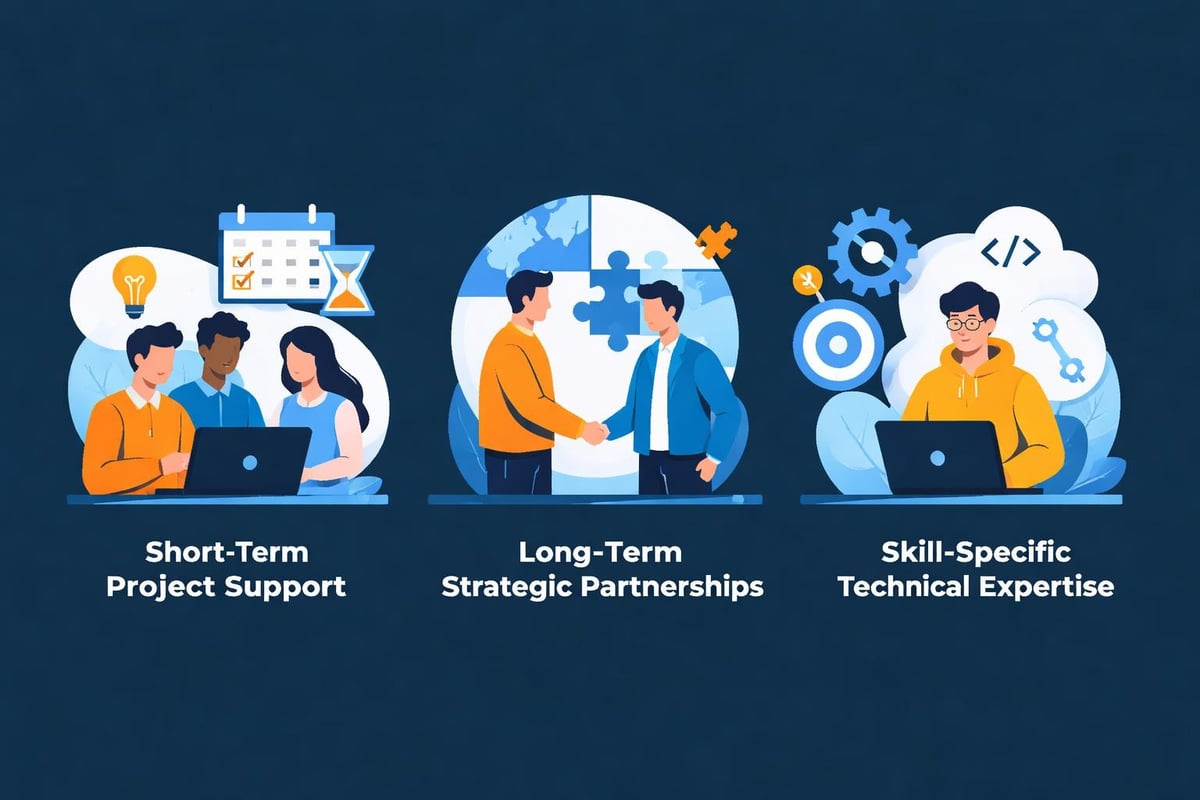
Organizations can choose from several it staff augmentation services models depending on their specific needs:
Short-term augmentation addresses immediate project demands, typically lasting from a few weeks to several months. Companies leverage this model for product launches, system migrations, or seasonal workload spikes.
Long-term augmentation extends beyond six months and often continues for years, providing sustained support for ongoing initiatives. This model suits organizations building specialized capabilities without committing to permanent headcount expansion.
Skill-specific augmentation targets particular technical competencies, from cloud architecture to machine learning engineering. Businesses use this approach when internal teams lack expertise in emerging technologies or niche domains.
| Model Type | Duration | Best For | Budget Impact |
|---|---|---|---|
| Short-term | 1-6 months | Sprint projects, urgent gaps | Lower commitment |
| Long-term | 6+ months | Sustained growth, strategic initiatives | Predictable costs |
| Skill-specific | Variable | Specialized expertise, new technologies | Higher hourly rates |
The engagement model you select should align with your project scope, budget constraints, and strategic workforce planning objectives.
Strategic Advantages of Technical Talent Augmentation
Companies implementing it staff augmentation services gain access to benefits that traditional hiring cannot match. Speed stands as the primary advantage, with augmented professionals often onboarding within days rather than the months required for permanent recruitment.
Financial Efficiency
Augmentation eliminates numerous costs associated with permanent employees. Organizations avoid expenses related to benefits packages, office space, equipment, training programs, and severance obligations. Instead, they pay only for productive hours worked on specific deliverables.
- Reduced recruiting overhead and time-to-hire expenses
- No long-term compensation commitments or benefits administration
- Elimination of bench time during project gaps
- Predictable budgeting with defined hourly or project rates
Access to Specialized Expertise
The technology landscape evolves rapidly, making it impractical for companies to maintain full-time staff in every emerging domain. IT staff augmentation services provide on-demand access to professionals with cutting-edge skills in artificial intelligence, blockchain development, cybersecurity, and other specialized fields.
Many organizations discover that hiring managers benefit tremendously from augmentation when building teams for new product lines or entering unfamiliar technical territories.
Scalability and Flexibility
Business demands fluctuate throughout the year. Augmentation enables teams to scale up during peak periods and scale down when projects conclude, maintaining optimal resource allocation without the complications of layoffs or reorganizations.
Identifying When Augmentation Makes Sense
Not every hiring need calls for it staff augmentation services. Understanding when this approach delivers maximum value helps organizations make informed staffing decisions.
Project-based work with defined timelines represents the ideal use case. When you need to deliver a mobile application, migrate to cloud infrastructure, or implement a data analytics platform within a specific timeframe, augmented professionals provide the necessary firepower without permanent obligations.
Skill gaps in emerging technologies create another compelling scenario. As your business adopts new platforms or methodologies, bringing in experienced practitioners accelerates learning curves and reduces implementation risks.
Warning Signs You Need Augmentation
- Critical projects stalling due to insufficient technical capacity
- Permanent staff overwhelmed by workload, leading to burnout
- Delayed product launches impacting revenue targets
- Inability to compete for rare technical skills in tight talent markets
- Budget constraints preventing permanent headcount expansion
Organizations facing multiple indicators simultaneously should seriously evaluate augmentation as a strategic solution rather than a temporary fix.
Selecting the Right Service Provider
Top IT staff augmentation companies distinguish themselves through rigorous vetting processes, candidate quality, and client support. The selection process requires careful evaluation across multiple dimensions.
Vetting and Quality Assurance
The caliber of augmented professionals directly impacts project outcomes. Superior providers implement comprehensive screening protocols that verify technical competencies, assess communication abilities, and validate professional backgrounds.
Platforms like Augmnt ATS integrate candidate fraud detection and skill verification directly into the recruitment workflow, ensuring businesses receive only qualified, authenticated professionals. This validation layer eliminates the risk of resume fraud and misrepresented qualifications that plague traditional staffing channels.
Industry Specialization
Some augmentation firms specialize in particular sectors such as healthcare, finance, or e-commerce. Domain expertise enables providers to understand your specific compliance requirements, technical standards, and business context more thoroughly.

| Evaluation Criteria | Why It Matters | Questions to Ask |
|---|---|---|
| Vetting rigor | Ensures candidate quality | What technical assessments do candidates complete? |
| Replacement policy | Protects against bad fits | How quickly can you replace underperforming staff? |
| Time-to-placement | Impacts project timelines | What's your average time from request to candidate start? |
| Communication support | Reduces friction | How do you handle timezone and language challenges? |
Integration Best Practices for Augmented Teams
Successfully incorporating external professionals into existing teams requires intentional planning and cultural sensitivity. Organizations that treat augmented staff as temporary outsiders typically experience communication breakdowns, misaligned priorities, and suboptimal results.
Onboarding and Cultural Alignment
Augmented professionals need the same context and access as permanent employees. Comprehensive onboarding should cover:
- Technical environment setup including code repositories, development tools, and authentication credentials
- Process documentation explaining workflows, approval chains, and communication protocols
- Team introductions that establish relationships and clarify roles
- Project context detailing business objectives, success metrics, and stakeholder expectations
Many leading staff augmentation firms emphasize that integration quality directly correlates with project success rates.
Communication and Collaboration
Establish clear communication channels from day one. Augmented team members should participate in daily standups, sprint planning sessions, and retrospectives alongside permanent staff. Excluding them from key discussions creates information silos and reduces productivity.
Collaboration tools matter significantly when working with distributed augmented teams. Standardize on platforms for project management, code collaboration, and real-time communication to ensure everyone operates from the same information base.
Performance Management
Apply the same performance standards to augmented professionals as you would to permanent employees. Regular feedback cycles, clear deliverable expectations, and objective success metrics create accountability and drive results.
Navigating Common Challenges
IT staff augmentation services present specific challenges that organizations must anticipate and address proactively. Understanding potential obstacles enables teams to develop mitigation strategies before problems emerge.
Knowledge Transfer and Continuity
Augmented professionals eventually transition off projects, taking accumulated knowledge with them. Combat this risk through systematic documentation practices, pair programming with permanent staff, and structured knowledge transfer sessions before departure.
- Maintain detailed project wikis updated throughout engagement
- Record architectural decisions and rationale
- Schedule overlap periods between departing and replacement staff
- Conduct exit interviews to capture lessons learned
Security and Compliance Considerations
Granting external professionals access to proprietary systems and sensitive data introduces security risks. Robust governance frameworks protect organizational assets while enabling augmented staff to perform their duties effectively.
Implement role-based access controls that limit permissions to only necessary systems. Require confidentiality agreements before granting access. Monitor augmented staff activities through audit logs and security information systems.

Cultural and Communication Barriers
Global IT staff augmentation companies often provide talent from diverse geographic regions and cultural backgrounds. While this diversity brings valuable perspectives, it can also create communication challenges and cultural misunderstandings.
Address these challenges through cultural sensitivity training, flexible meeting schedules that accommodate different timezones, and explicit communication norms that prevent misinterpretation.
Cost Structure and Budget Planning
Understanding the financial mechanics of it staff augmentation services enables accurate budget forecasting and vendor negotiations. Pricing models vary significantly across providers and engagement types.
Rate Determinants
Multiple factors influence augmentation rates:
Geographic location substantially impacts pricing, with professionals from North America and Western Europe commanding premium rates compared to talent from Eastern Europe, Latin America, or Asia.
Skill rarity drives significant rate variation. Common skills like front-end development typically cost less than specialized expertise in quantum computing or advanced AI model optimization.
Experience level creates additional differentiation. Junior developers might bill at $50-75 per hour while senior architects command $150-250 or more.
| Experience Level | Typical Hourly Range | Best For |
|---|---|---|
| Junior (1-3 years) | $50-$90 | Routine coding, testing, maintenance |
| Mid-level (3-7 years) | $90-$140 | Feature development, implementation |
| Senior (7-12 years) | $140-$200 | Architecture, complex problem-solving |
| Expert (12+ years) | $200-$300+ | Strategy, specialized domains, leadership |
Hidden Costs to Consider
Beyond hourly rates, organizations should budget for management overhead, knowledge transfer time, and potential productivity ramps. New augmented staff typically require 2-4 weeks to reach full productivity as they familiarize themselves with your codebase, processes, and business context.
Measuring Augmentation Success
Effective performance measurement ensures it staff augmentation services deliver expected value. Establish clear metrics before engagements begin to enable objective evaluation.
Quantitative Indicators
Track concrete metrics that reflect augmentation impact:
- Time-to-productivity: Days from start date to meaningful contribution
- Velocity improvement: Increased story points or features delivered per sprint
- Defect rates: Quality metrics compared to permanent staff baseline
- Project timeline adherence: Percentage of milestones met on schedule
- Cost per deliverable: Total augmentation spend divided by completed features
Organizations can compare these metrics against internal benchmarks and industry standards to assess provider performance.
Qualitative Assessment
Numbers tell only part of the story. Regular feedback from permanent team members reveals integration quality, communication effectiveness, and cultural fit. Conduct monthly pulse surveys asking permanent staff to rate augmented colleagues on collaboration, technical contribution, and professionalism.
Stakeholder satisfaction provides another critical indicator. Project sponsors and business leaders should evaluate whether augmented teams deliver solutions that meet business requirements and user needs.
Future Trends Shaping Augmentation Services
The it staff augmentation services landscape continues evolving rapidly as technology advances and workforce dynamics shift. Several trends will significantly impact how organizations leverage augmentation through 2026 and beyond.
AI-Enhanced Matching
Innovative platforms now apply artificial intelligence to candidate-project matching, analyzing technical skills, experience patterns, and project requirements to identify optimal fits faster and more accurately than traditional recruiting methods. This technology reduces time-to-placement while improving match quality and long-term engagement success rates.
Specialized AI Talent Demand
As artificial intelligence permeates every industry, demand for AI specialists has skyrocketed beyond available supply. Organizations increasingly rely on augmentation to access machine learning engineers, data scientists, and AI ethics specialists who remain scarce in traditional labor markets.
Companies can explore verified AI talent marketplaces that specifically focus on connecting businesses with authenticated artificial intelligence professionals.
Hybrid Workforce Models
The distinction between permanent employees and augmented staff continues blurring. Progressive organizations now maintain "core-flex" workforce strategies where a stable core team collaborates continuously with a rotating group of specialized augmented professionals, creating dynamic capabilities that adapt to changing business needs.
Outcome-Based Pricing
Traditional hourly billing models are gradually giving way to outcome-based arrangements where augmentation providers commit to specific deliverables rather than time inputs. This shift aligns incentives more closely between clients and providers while reducing micromanagement overhead.
Risk Mitigation Strategies
Prudent organizations approach it staff augmentation services with comprehensive risk management frameworks that protect business interests while maximizing augmentation benefits.
Contractual Protections
Robust contracts clearly define expectations, responsibilities, and remedies. Essential elements include:
- Detailed scope descriptions specifying required skills, deliverables, and timelines
- Performance standards establishing measurable quality criteria
- Replacement provisions enabling quick substitution of underperforming staff
- Intellectual property clauses ensuring work product ownership
- Termination terms allowing exit without excessive penalty
Legal review of augmentation agreements protects against ambiguous language that could create disputes later.
Vendor Diversification
Relying on a single augmentation provider creates dependency risk. Maintain relationships with multiple vendors to ensure continuity if a primary provider experiences capacity constraints, quality issues, or business disruptions. This approach also enables competitive benchmarking and rate negotiations.
Knowledge Retention Systems
Systematic knowledge capture prevents critical information from leaving when augmented professionals transition off projects. Implement mandatory documentation standards, regular knowledge sharing sessions, and architectural decision records that preserve institutional knowledge regardless of staff turnover.
Organizations can integrate these practices into their recruitment workflows to ensure consistency across both permanent and augmented hiring processes.
Building Long-Term Augmentation Strategies
Treating staff augmentation as a tactical band-aid undermines its strategic potential. Organizations achieving maximum value from it staff augmentation services integrate augmentation into their long-term workforce planning and talent management frameworks.
Capability Mapping
Conduct regular assessments identifying which capabilities require permanent internal ownership versus temporary augmentation. Core competencies that differentiate your business competitively should generally reside within permanent teams, while peripheral or cyclical needs suit augmentation well.
This strategic lens prevents over-reliance on external talent for mission-critical functions while maximizing flexibility for variable workloads.
Preferred Provider Programs
Establish preferred provider relationships with top-performing augmentation companies that consistently deliver quality talent aligned with your culture and standards. Preferred status might include volume discounts, priority access to candidates, and streamlined procurement processes.
Augmentation-Ready Culture
Organizations that successfully leverage augmented talent cultivate cultures welcoming external professionals as valued contributors rather than temporary outsiders. This cultural foundation manifests through inclusive practices, knowledge sharing norms, and recognition programs that celebrate augmented team member contributions.
Companies can explore partnership opportunities that formalize these relationships and create mutual value over time.
IT staff augmentation services provide organizations with the agility and expertise needed to navigate today's fast-paced technical landscape while maintaining fiscal discipline and operational flexibility. By understanding engagement models, selecting quality providers, implementing strong integration practices, and measuring outcomes systematically, businesses can leverage augmentation as a strategic workforce capability rather than merely a tactical staffing solution. Augmnt streamlines this entire process by connecting you with verified AI professionals through an intelligent marketplace that eliminates candidate fraud and ensures quality matches from day one. Discover how our platform can accelerate your technical hiring while reducing risk and improving outcomes.