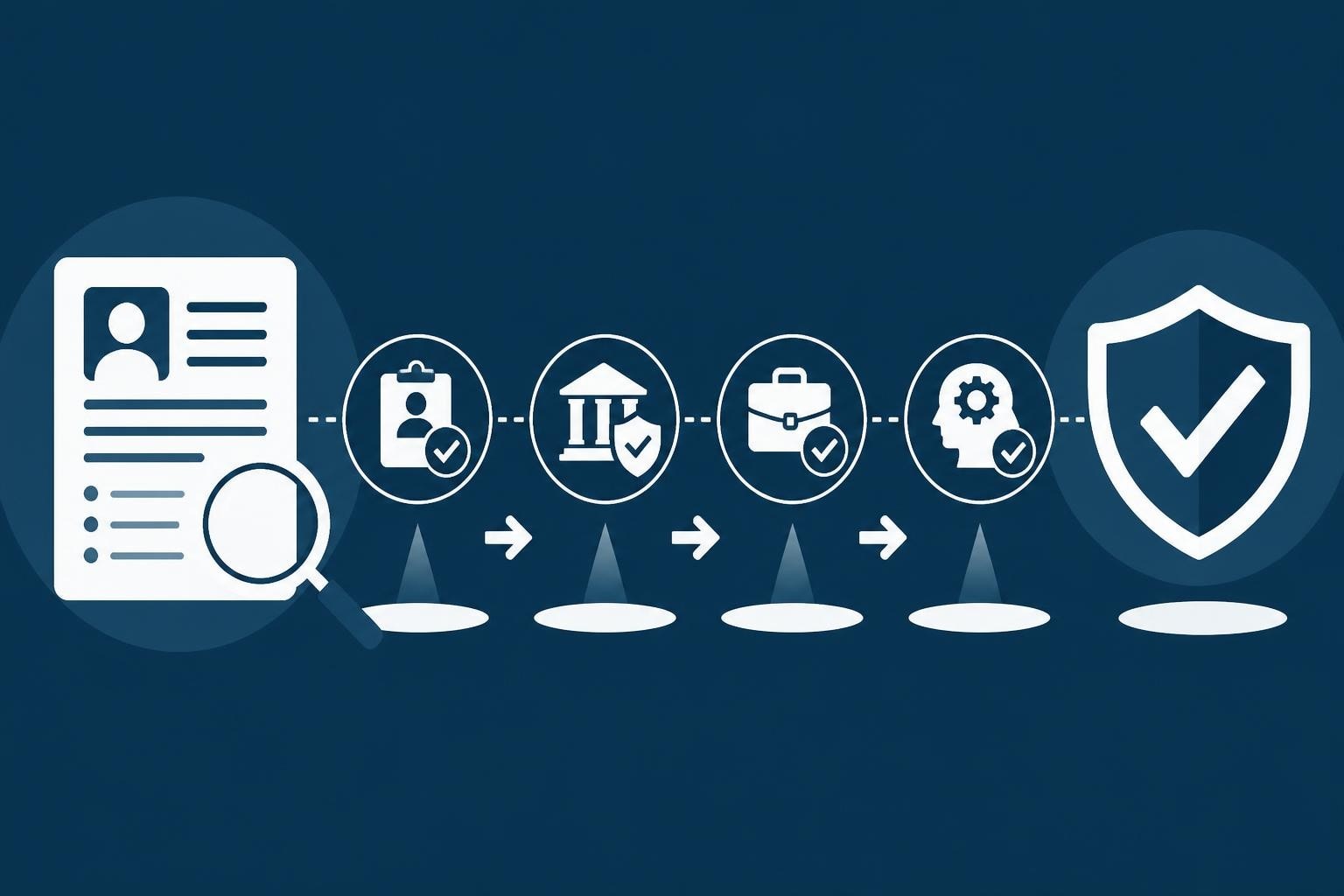
How to Detect Fake Resumes: A Verification Guide
Resume fraud has become increasingly sophisticated in 2026, with candidates using advanced AI tools, fabricated credentials, and misleading employment histories to secure positions they aren't qualified for. For businesses seeking specialized talent, particularly in technical fields like artificial intelligence, the stakes are even higher. Understanding how to detect fake resumes is no longer optional-it's a critical skill that protects your organization from costly hiring mistakes, project failures, and potential legal issues. This comprehensive guide explores the methods, technologies, and best practices that enable recruiters and hiring managers to identify fraudulent applications before they impact your team.
The Growing Challenge of Resume Fraud
The landscape of resume falsification has evolved dramatically over recent years. According to industry research, approximately 78% of resumes contain misleading information, ranging from minor embellishments to complete fabrications. The advent of generative AI has only accelerated this trend, making it easier for candidates to create convincing but entirely fictional career narratives.
Common types of resume fraud include:
- Fabricated employment history with non-existent companies
- Inflated job titles and responsibilities
- Falsified educational credentials and degrees
- Exaggerated technical skills and certifications
- Manipulated employment dates to hide gaps
- Stolen accomplishments from colleagues or online sources
The financial impact of hiring based on fake resumes extends far beyond recruitment costs. Organizations face productivity losses, team disruption, project delays, and potential legal liability when unqualified candidates are placed in critical roles.
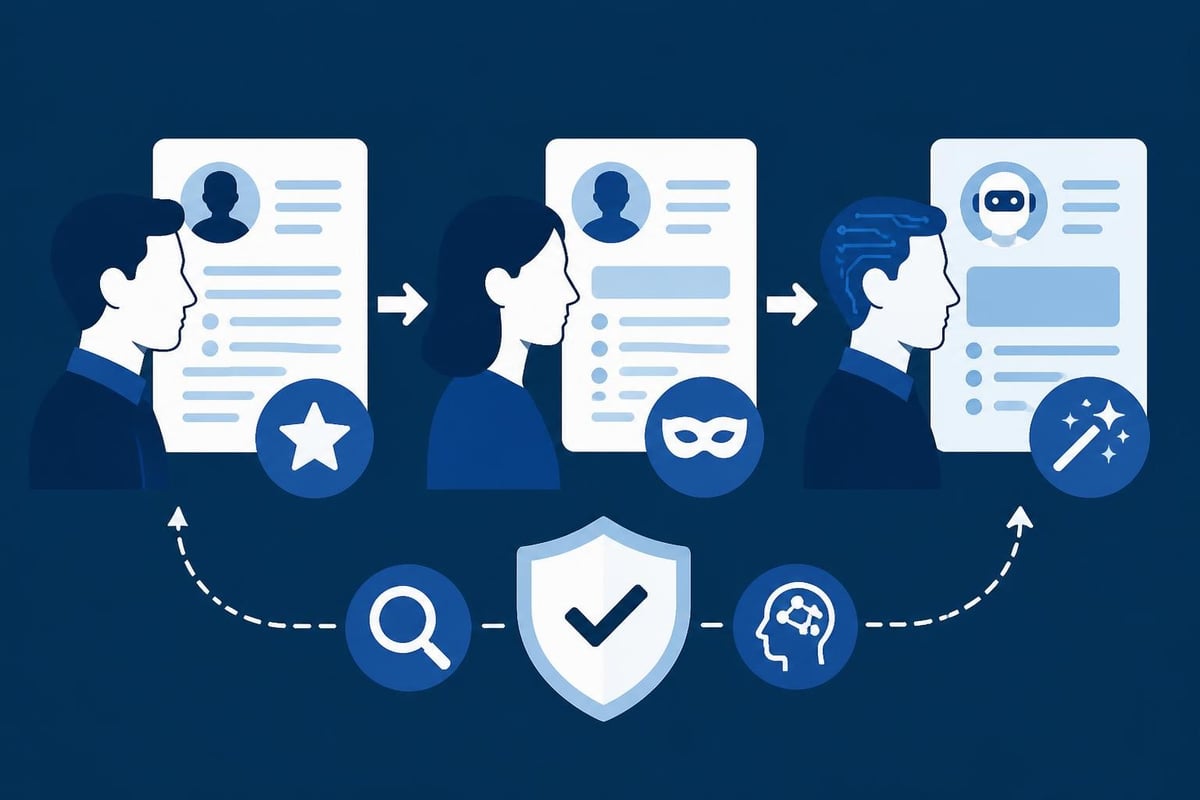
Critical Red Flags in Resume Screening
Learning how to detect fake resumes begins with recognizing patterns that indicate potential fraud. While no single red flag guarantees deception, multiple warning signs warrant deeper investigation.
Inconsistent Timeline and Employment Gaps
Authentic career progressions follow logical patterns. Suspicious timelines often reveal themselves through:
- Overlapping employment dates that suggest impossible simultaneous positions
- Conspicuous gaps without reasonable explanations
- Rapid job-hopping without career advancement
- Unusually short tenures at multiple companies (under six months)
Candidates sometimes manipulate dates by listing only years instead of specific months, or they extend employment periods to cover unemployment gaps. Cross-reference the timeline against LinkedIn profiles and other professional networks to identify discrepancies.
Vague or Unverifiable Company Information
Fake resumes often feature employers that are difficult or impossible to verify. Warning signs include:
| Red Flag | What to Check |
|---|---|
| Generic company names | Search for official websites and business registration |
| Missing company locations | Verify physical addresses and office presence |
| No online presence | Check LinkedIn company pages and professional directories |
| Defunct businesses | Confirm operational status during claimed employment period |
Some candidates create entirely fictitious companies or claim employment at legitimate businesses where they never worked. Always verify company existence through multiple sources, including business registries, professional networks, and direct contact when possible.
Suspiciously Perfect Language and Formatting
The rise of AI writing tools has created a new challenge: resumes that are too polished. While professional presentation is expected, certain linguistic patterns suggest automated generation rather than authentic human writing.
Watch for overly sophisticated vocabulary that doesn't match the candidate's communication style during initial interactions. Repetitive phrasing across different job descriptions, generic achievement statements without specific metrics, and perfectly formatted documents without any minor inconsistencies can all indicate AI assistance or template copying.
Verification Methods for Employment History
Once you've identified potential red flags, systematic verification becomes essential. Employment history validation forms the cornerstone of how to detect fake resumes effectively.
Direct Employer Contact
The most reliable verification method involves contacting previous employers directly:
- Call the company's main line rather than numbers provided by the candidate
- Speak with HR departments or direct supervisors when possible
- Verify exact job titles, employment dates, and general responsibilities
- Ask about eligibility for rehire (often revealing regarding performance)
- Document all verification attempts and responses
Be aware that some companies have policies limiting the information they'll share. Many will only confirm dates of employment and job titles, which still provides valuable validation.
Background Check Services
Professional background screening companies offer comprehensive verification services that go beyond basic employment checks. These services typically include:
- Multi-state criminal record searches
- Education verification with direct institution contact
- Professional license validation
- Credit history (when relevant to the position)
- Reference interviews with structured questions
While background checks require candidate consent and involve costs, they're essential for senior positions or roles with access to sensitive information or significant budgets.
Digital Footprint Analysis
Modern verification extends beyond traditional methods. A candidate's digital presence should align with their resume claims. Cross-verify online profiles across multiple platforms to ensure consistency.
Compare LinkedIn employment history with resume dates and descriptions. Search for professional contributions such as published articles, conference presentations, or GitHub repositories for technical candidates. Examine the timeline of social media posts for context about their claimed locations and activities during specific employment periods.

Educational Credential Verification
Educational fraud represents a significant portion of resume falsification. Detecting fake educational credentials requires targeted investigation techniques.
Degree Mills and Diploma Fraud
Not all educational institutions are legitimate. Degree mills sell credentials without requiring coursework or maintaining accreditation standards. Research any unfamiliar institutions through the U.S. Department of Education's database of accredited schools.
Key verification steps include:
- Confirming institutional accreditation status
- Contacting registrar offices directly for degree verification
- Requesting official transcripts sent directly from the institution
- Verifying that degrees match the field of study claimed
- Checking graduation dates against employment timelines
For international degrees, use credential evaluation services that specialize in foreign education verification. These services confirm institutional legitimacy and translate qualifications into U.S. equivalents.
Professional Certifications and Licenses
Technical certifications carry significant weight in fields like AI development, data science, and software engineering. Fortunately, most certification bodies maintain public verification databases.
Create a systematic process for validating claimed certifications by checking issuing organization databases, verifying certification numbers when provided, and confirming that certifications were valid during the claimed timeframe (as many require renewal).
For specialized AI roles, platforms like Augmnt integrate verification processes directly into the matching system, ensuring candidates possess validated credentials before being presented to employers.
Technical Skill Assessment Beyond the Resume
Understanding how to detect fake resumes includes recognizing that documentation alone never tells the complete story. Practical skill validation is essential, particularly for technical positions.
Structured Technical Interviews
Design interviews that test actual capabilities rather than memorized responses. For AI professionals, this might include:
- Live coding exercises with real-world problem scenarios
- System design discussions that reveal architectural thinking
- Debugging challenges using unfamiliar codebases
- Algorithm optimization questions requiring deep understanding
- Case studies involving actual business problems
Pay attention to how candidates explain their thinking process. Authentic expertise reveals itself through nuanced understanding, awareness of trade-offs, and ability to discuss alternative approaches.
Work Sample Evaluation
Request work samples that demonstrate claimed skills. For developers, review GitHub repositories or request code portfolios. For data scientists, ask for examples of analysis or model development (with sensitive information redacted).
Evaluate work samples for:
- Code quality and best practices
- Problem complexity appropriate to experience level
- Documentation and commenting standards
- Consistency with claimed expertise areas
- Original work versus copied solutions
Be cautious of candidates who cannot provide any work samples or whose samples show significant quality variations suggesting multiple authors.
Skills Testing Platforms
Standardized assessment tools provide objective skill measurement. These platforms offer validated tests for programming languages, frameworks, data analysis tools, and AI methodologies.
Combine automated assessments with human review. While testing platforms identify technical knowledge gaps, they may not capture problem-solving abilities or practical application skills that emerge during real project work.
Leveraging AI and Technology for Fraud Detection
Just as fraudsters use AI to create fake resumes, AI-driven solutions can detect fraudulent applications through pattern analysis and anomaly detection.
Automated Resume Screening
Modern applicant tracking systems incorporate fraud detection features that flag suspicious patterns. These systems analyze thousands of data points to identify anomalies such as:
- Statistical improbabilities in career progression
- Language patterns consistent with AI generation
- Formatting similarities to known fraudulent templates
- Inconsistencies between different sections of the resume
- Matches to databases of previously identified fake credentials
Machine learning models trained on verified legitimate resumes can identify outliers that warrant human investigation. However, AI screening should complement rather than replace human judgment.
Behavioral Analysis During Application
Research on prompt injection attacks reveals vulnerabilities in automated screening systems. Understanding these attack vectors helps organizations develop more robust verification processes.
Monitor application behavior for suspicious patterns such as multiple applications from similar profiles, rapid-fire submissions suggesting automated tools, and unusual access patterns indicating bot activity. Track IP addresses and device fingerprints to identify coordinated fraud attempts.
Continuous Verification Throughout Hiring
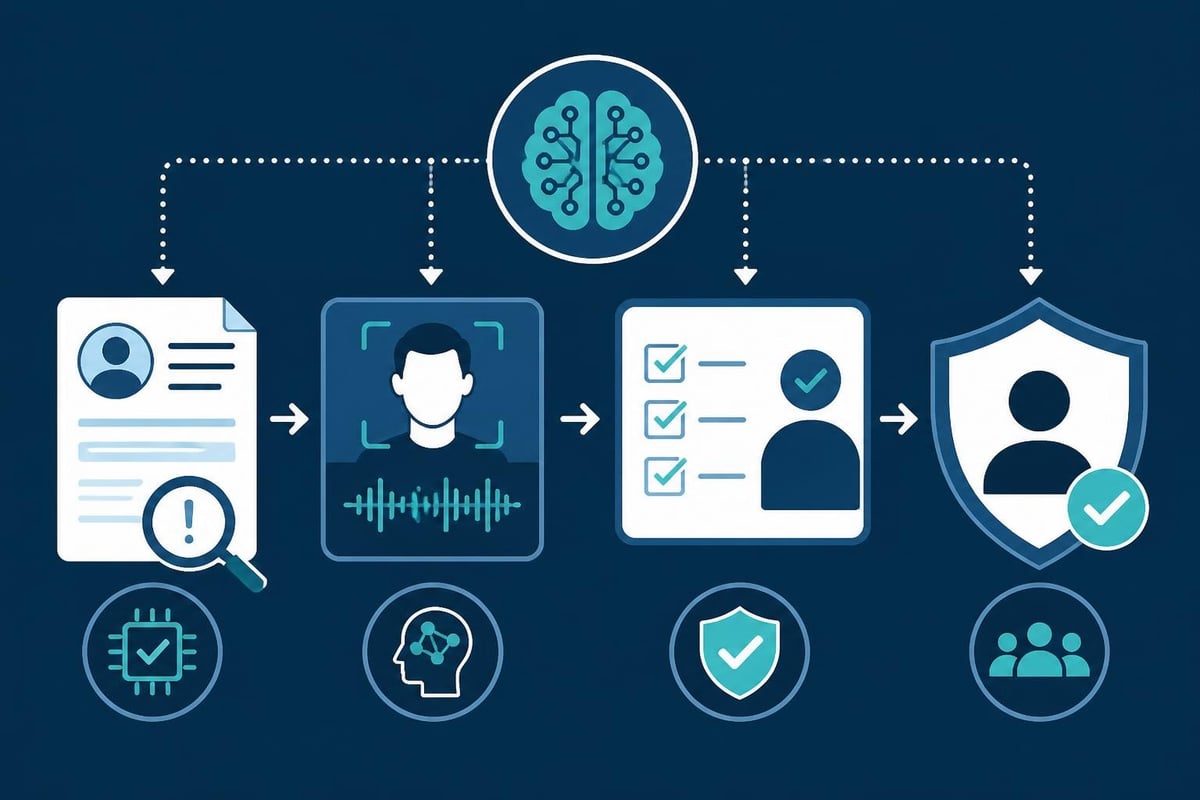
Verification shouldn't stop after initial screening. Implement checkpoints throughout your hiring pipeline:
| Stage | Verification Activity |
|---|---|
| Application | Automated resume analysis and red flag detection |
| Phone Screen | Voice verification and preliminary reference checks |
| Technical Interview | Live skill demonstration and knowledge assessment |
| Final Interview | In-depth background verification and peer interviews |
| Offer Stage | Comprehensive background check and credential validation |
This layered approach ensures that fraudulent candidates are filtered out before they consume significant interviewing resources or reach the offer stage.
Reference Check Best Practices
References provide crucial validation, but only when checked properly. Many candidates provide friends or relatives as fake references, making thorough verification essential.
Structured Reference Interviews
Develop standardized questions that reveal authentic working relationships. Ask references to describe specific projects they collaborated on with the candidate. Request examples of how the candidate handled challenges or conflicts. Question them about the candidate's technical strengths and development areas.
Effective reference check questions include:
- "In what capacity did you work with this candidate?"
- "Can you describe a specific project where you observed their [claimed skill]?"
- "What were their primary responsibilities in their role?"
- "How did their performance compare to peers in similar positions?"
- "Would you rehire this person if you had the opportunity?"
Listen for vague or hesitant responses that might indicate an inauthentic reference relationship. Genuine references typically provide detailed, nuanced feedback without excessive praise or criticism.
Verifying Reference Authenticity
Before accepting reference feedback, verify that references are who they claim to be. Search LinkedIn to confirm the reference held a position where they would have worked with the candidate. Call the company directly and ask to be transferred to the reference rather than using provided phone numbers. Cross-reference email addresses with company domains rather than accepting personal email addresses without verification.
Some candidates coach references on what to say or provide references who will lie on their behalf. Asking specific, detailed questions about projects and circumstances makes coached responses more difficult.
Building a Fraud-Resistant Hiring Process
Knowing how to detect fake resumes is only part of the solution. Organizations need systematic processes that prevent fraudulent candidates from advancing through the pipeline.
Documentation and Audit Trails
Maintain detailed records of all verification activities. Document who was contacted, when, what information was confirmed, and any discrepancies discovered. This documentation protects your organization if hiring decisions are later questioned and creates accountability for thorough verification.
Create standardized verification checklists for different role levels. Entry-level positions might require basic employment and education verification, while senior roles demand comprehensive background checks, multiple references, and extensive skill validation.
Team Training and Awareness
Your hiring team represents your first line of defense against resume fraud. Regular training on identifying red flags and verification techniques ensures consistent application of fraud detection methods.
Train interviewers to recognize inconsistencies between resume claims and candidate responses. Teach them to probe deeper when answers seem rehearsed or overly vague. Establish clear escalation protocols when fraud is suspected so that appropriate investigation occurs before proceeding.
Legal and Ethical Considerations
Verification activities must comply with employment laws and privacy regulations. Always obtain candidate consent before conducting background checks. Provide adverse action notices if verification findings lead to rejection. Ensure that verification methods are applied consistently across all candidates to avoid discrimination claims.
Maintain confidentiality of information discovered during verification. Use findings only for hiring decisions, and restrict access to sensitive information to those with legitimate business needs.
Industry-Specific Verification Challenges
Different industries face unique resume fraud challenges requiring specialized verification approaches. For organizations hiring AI professionals, technical skill validation becomes particularly complex due to the rapid evolution of the field.
Verifying AI and Machine Learning Expertise
AI expertise claims are difficult to validate through traditional methods. Candidates may claim familiarity with frameworks they've barely used or exaggerate their role in AI projects. Effective verification requires:
Technical deep-dives that explore architectural decisions and model selection rationale. Discussions of specific algorithms and their trade-offs in different scenarios. Questions about handling common AI challenges like overfitting, data imbalance, or model interpretability. Requests for concrete examples of model performance improvements they've achieved.
Consider exploring verified talent marketplaces that pre-screen candidates for technical competency, saving significant verification time and reducing fraud risk.
Remote Work Verification Complexities
Remote hiring introduces additional fraud vectors. Without in-person interviews, verifying candidate identity becomes challenging. Use video interviews with cameras enabled to confirm identity matches provided documents. Request government-issued identification during final interview stages. Consider identity verification services for high-risk positions.
Remote talent pool screening requires enhanced digital verification since traditional in-person validation isn't possible.
Red Flags Specific to AI-Generated Resumes
As generative AI becomes more sophisticated, detecting AI-created resumes requires new strategies. AI-generated content often exhibits telltale patterns that careful screening can identify.
Look for generic achievement descriptions that lack specific metrics or context. AI tends to produce grammatically perfect but substantively shallow descriptions. Watch for unusual consistency in writing style across all positions, as humans naturally evolve their writing over time.
Compare resume content against the candidate's communication style in cover letters, emails, and initial conversations. Significant discrepancies suggest that different authors (or AI tools) created different documents.
Request that candidates explain specific achievements in their own words during phone screens. Candidates with AI-generated resumes often struggle to provide details beyond what's written because they didn't actually have those experiences.
Creating a Multi-Layered Defense Strategy
The most effective approach to how to detect fake resumes combines multiple verification methods into a comprehensive system. No single technique catches all fraud, but layered defenses significantly reduce the risk of hiring based on falsified credentials.
Your verification strategy should include:
- Automated resume screening for obvious red flags
- Manual review by experienced recruiters for subtle inconsistencies
- Systematic employment and education verification
- Practical skill assessments appropriate to the role
- Structured interviews with behavioral and technical components
- Thorough reference checks with verified contacts
- Comprehensive background screening for final candidates
Adjust the intensity of verification based on role criticality and risk factors. Senior positions, roles with financial authority, and positions accessing sensitive data warrant more extensive verification than entry-level roles with limited responsibility.
Measuring Verification Effectiveness
Track metrics that reveal your fraud detection success rates. Monitor the percentage of candidates who fail verification at different pipeline stages. Measure time-to-verify and associated costs to optimize efficiency. Track false positive rates where legitimate candidates are incorrectly flagged for additional scrutiny.
Analyze fraud detection patterns to identify common sources of fake resumes. If certain job boards or referral sources consistently produce fraudulent applications, adjust your sourcing strategy accordingly. Share findings with your recruitment team to continuously improve detection capabilities.
Calculate the cost savings from fraud prevention by estimating the expense of hiring, onboarding, and eventually replacing an unqualified candidate. This demonstrates ROI for investment in verification tools and processes.
Maintaining Candidate Experience During Verification
Rigorous verification shouldn't create negative candidate experiences. Legitimate candidates understand and expect reasonable verification, but excessive delays or intrusive requests can damage your employer brand.
Communicate transparently about verification timelines and requirements. Explain that thorough screening protects both the organization and candidates by ensuring good role fit. Request information respectfully and handle sensitive data with appropriate confidentiality.
Streamline verification by conducting multiple checks simultaneously rather than sequentially. Leverage technology to automate routine verifications, freeing human resources for complex investigations. Provide regular status updates so candidates don't feel abandoned during background check periods.
For organizations seeking to balance thorough verification with efficient hiring, specialized platforms offer integrated solutions that maintain candidate engagement while ensuring credential authenticity.
Protecting your organization from resume fraud requires vigilance, systematic processes, and the right tools to verify candidate credentials effectively. By implementing multi-layered verification strategies and staying current with emerging fraud tactics, you can significantly reduce the risk of hiring based on fake resumes while maintaining an efficient recruitment process. Augmnt addresses these challenges by combining AI-powered screening with human expertise to deliver pre-verified candidates, eliminating fraud risk while accelerating your hiring timeline. Explore how verified talent matching can transform your recruitment process and ensure every candidate meets your standards before the first interview.