GCP for AI Companies: A Complete 2026 Implementation Guide
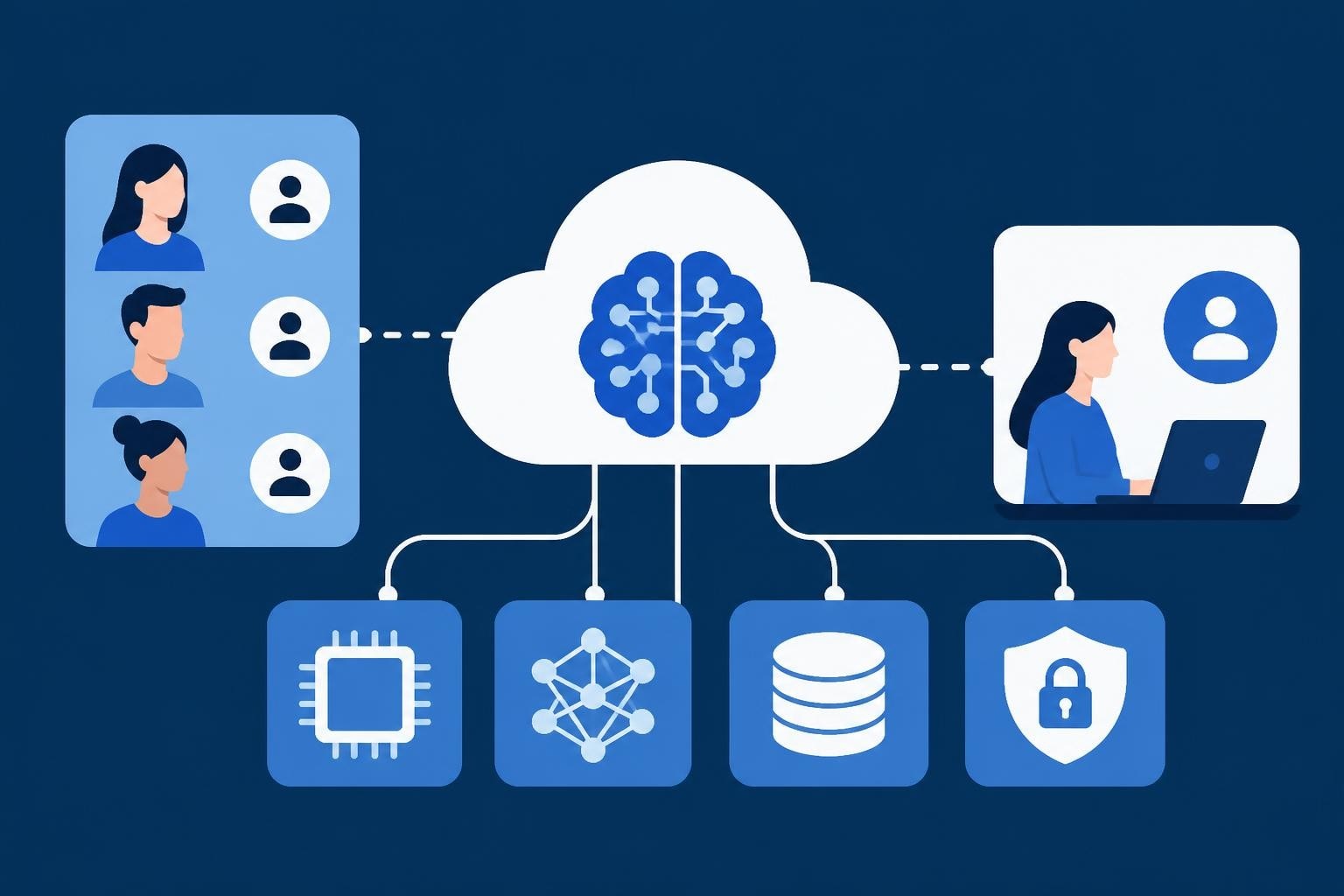
Google Cloud Platform has transformed how businesses build and scale their digital infrastructure, particularly for companies operating in the artificial intelligence space. For organizations running AI-driven talent marketplaces, GCP provides the robust foundation needed to handle complex matching algorithms, process vast amounts of candidate data, and maintain security standards that protect sensitive employment information. Understanding how to leverage GCP effectively can mean the difference between a platform that struggles under load and one that scales seamlessly with business growth.
Understanding GCP's Core Value for AI Talent Platforms
Google Cloud Platform represents one of the three major cloud providers, distinguished by its advanced AI and machine learning capabilities that originated from Google's own internal tools. The platform encompasses over 100 products spanning compute, storage, networking, databases, and specialized AI services.
For AI talent marketplaces, GCP delivers several critical advantages:
- Native integration with TensorFlow and other Google AI frameworks
- Pre-trained models through Vertex AI for faster development cycles
- Real-time data processing capabilities for instant candidate matching
- Enterprise-grade security compliant with SOC 2, ISO 27001, and GDPR requirements
- Global infrastructure with 39 regions and 118 zones worldwide
The official Google Cloud Documentation serves as the comprehensive resource for understanding these services. Getting started with the platform has become increasingly straightforward in 2026, with improved onboarding processes and clearer pricing structures that help businesses forecast their cloud spending accurately.
Key GCP Services for Recruitment Technology
Different GCP services address specific challenges in talent marketplace operations. Compute Engine provides virtual machines that can scale up during peak hiring seasons, while Cloud Storage offers economical long-term retention of candidate profiles and documentation.
| Service Category | Primary GCP Product | Use Case for AI Hiring |
|---|---|---|
| Machine Learning | Vertex AI | Candidate-job matching algorithms |
| Compute | Compute Engine | Backend API processing |
| Database | Cloud SQL / Firestore | Candidate and employer data management |
| Security | Cloud Identity | Access control and authentication |
| Analytics | BigQuery | Hiring metrics and reporting |
Cloud Run has emerged as particularly valuable for containerized applications that need to scale automatically based on demand. When a talent platform experiences sudden traffic spikes from employer searches or candidate applications, Cloud Run adjusts resources without manual intervention.
Implementing GCP for Scalable AI Operations
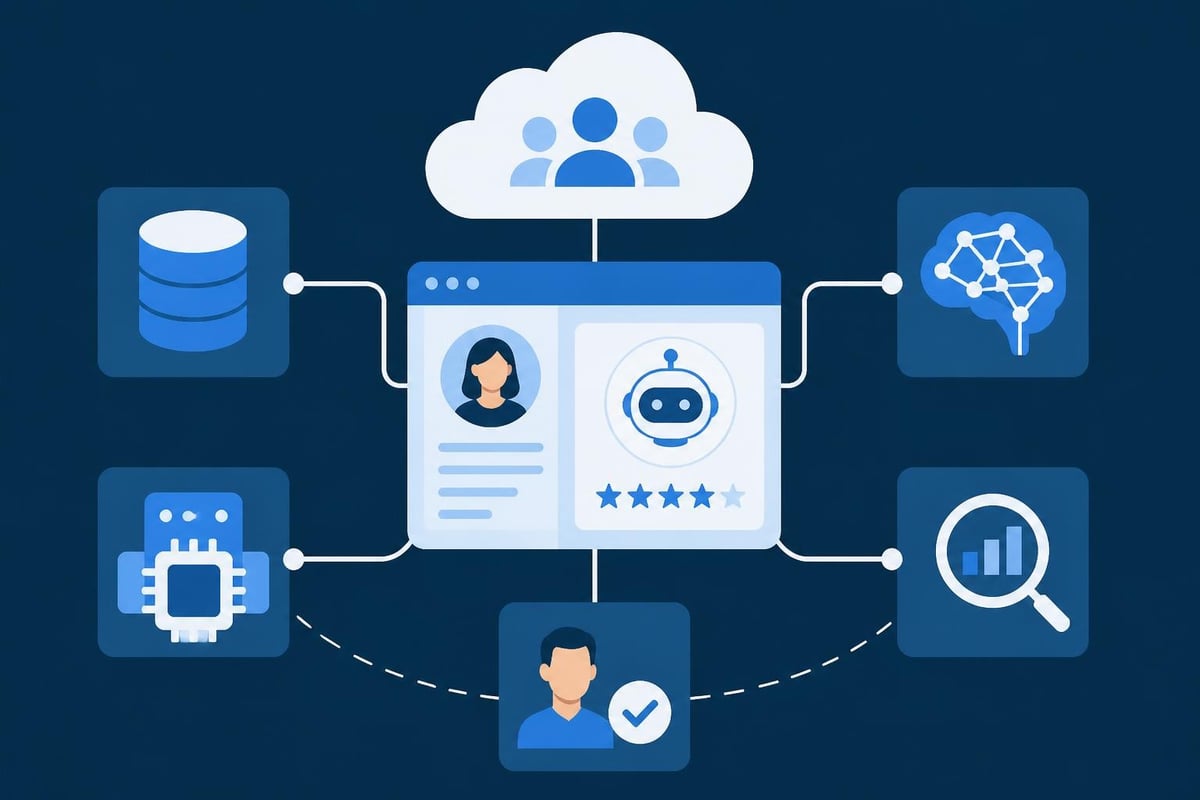
Building on GCP requires strategic decisions about service selection and architecture design. The Get Started with Google Cloud guide walks through account creation, project setup, and initial resource provisioning. Most businesses begin with a proof-of-concept environment before migrating production workloads.
Setting Up Your GCP Environment
Initial configuration involves creating a project structure that separates development, staging, and production environments. This isolation prevents testing activities from affecting live operations and provides a safe space for experimenting with new features.
Essential setup steps include:
- Creating a Google Cloud account and linking billing information
- Establishing project hierarchies with appropriate IAM permissions
- Configuring VPC networks for secure resource communication
- Setting up Cloud Storage buckets for data persistence
- Deploying initial compute resources through Compute Engine or Cloud Run
The gcloud CLI streamlines these tasks through command-line automation. Rather than clicking through the web console repeatedly, development teams can script infrastructure deployment using Terraform or gcloud commands. This infrastructure-as-code approach ensures consistency across environments and enables rapid disaster recovery.
For AI talent platforms handling candidate verification and fraud detection, security configuration takes priority. Implementing service accounts with minimal necessary permissions follows the principle of least privilege, reducing potential attack surfaces.
Leveraging Vertex AI for Intelligent Matching
Vertex AI represents Google's unified machine learning platform, consolidating previously fragmented services into a cohesive environment. The Vertex AI documentation details how to train custom models, deploy pre-trained solutions, and manage the entire ML lifecycle.
AI-driven talent marketplaces rely on sophisticated algorithms that evaluate candidate qualifications against job requirements. Traditional keyword matching fails to capture semantic relationships between skills and experiences, leading to poor hiring outcomes.
Building Custom ML Models on GCP
Vertex AI provides AutoML capabilities that generate models without extensive data science expertise. For businesses with specific requirements around candidate matching or fraud detection, custom model training offers greater control over accuracy and performance.
The platform supports popular frameworks including:
- TensorFlow for deep learning applications
- PyTorch for research-oriented implementations
- Scikit-learn for traditional machine learning approaches
- XGBoost for gradient boosting applications
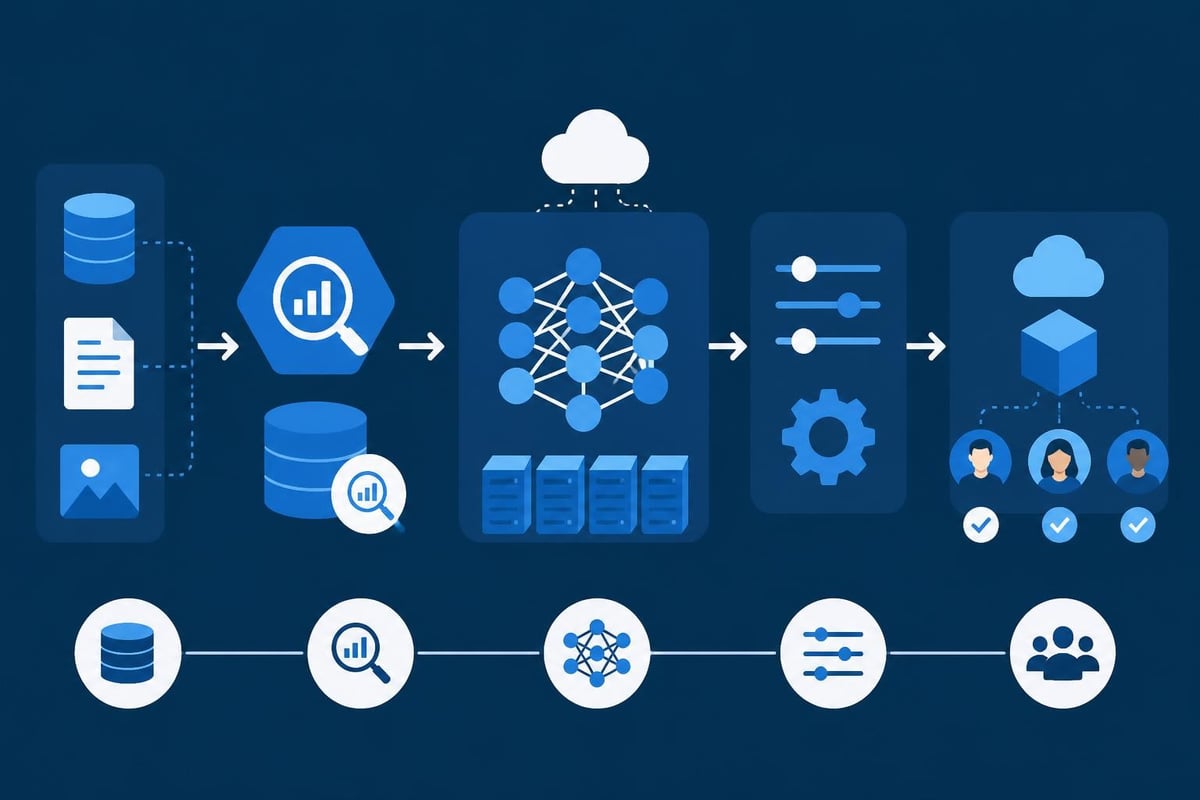
Model development workflow typically follows these phases:
- Data preparation using BigQuery for feature engineering
- Training execution on distributed GPU/TPU infrastructure
- Hyperparameter tuning through Vertex AI's optimization tools
- Model evaluation against validation datasets
- Deployment to prediction endpoints for real-time inference
Feature Store capabilities within Vertex AI enable consistent feature computation across training and serving, eliminating training-serving skew that degrades model performance. When a candidate's profile updates, features recalculate automatically and feed into matching predictions.
Data Management and Security Architecture
Talent platforms handle extraordinarily sensitive information including personal identifiable information (PII), employment histories, and proprietary business data. GCP provides comprehensive security controls that protect this information throughout its lifecycle.
Cloud SQL offers managed relational databases supporting PostgreSQL, MySQL, and SQL Server. For platforms requiring more flexible schemas, Firestore delivers document-based storage with real-time synchronization capabilities. The choice depends on data access patterns and consistency requirements.
Implementing Encryption and Access Controls
Data encryption must occur at rest and in transit. GCP automatically encrypts all data at rest using AES-256 encryption, while TLS 1.3 protects data moving between services and end users. For additional security, Customer-Managed Encryption Keys (CMEK) give organizations direct control over encryption key management.
| Security Feature | GCP Implementation | Business Value |
|---|---|---|
| Identity Management | Cloud Identity & IAM | Role-based access control for team members |
| Data Encryption | Default AES-256 + CMEK options | Compliance with data protection regulations |
| Network Security | VPC Service Controls | Prevent data exfiltration |
| Audit Logging | Cloud Audit Logs | Track all resource access and modifications |
| DDoS Protection | Cloud Armor | Defend against volumetric attacks |
Cloud Audit Logs record every interaction with GCP resources, creating an immutable trail for compliance audits. When investigating potential security incidents or verifying candidate data access, these logs provide detailed attribution of actions to specific user accounts.
For businesses utilizing Augmnt ATS for verified matching and fraud detection, GCP's security infrastructure ensures that candidate validation processes maintain data integrity while preventing unauthorized access to sensitive verification results.
Cost Optimization Strategies for GCP Deployments
Cloud costs can escalate quickly without proper monitoring and optimization. GCP provides several mechanisms for controlling spending while maintaining performance standards appropriate for production talent platforms.
Committed Use Discounts offer significant savings (up to 57%) for workloads with predictable resource consumption. By committing to specific CPU and memory allocations for one or three years, businesses reduce their compute costs substantially compared to on-demand pricing.
Effective cost management tactics include:
- Implementing auto-scaling policies that reduce resources during low-traffic periods
- Using Preemptible VMs for fault-tolerant batch processing workloads
- Archiving inactive candidate profiles to Coldline or Archive storage classes
- Setting budget alerts that notify stakeholders before spending thresholds breach
- Analyzing recommendations from Cloud Billing Reports to identify waste
BigQuery pricing operates on a query-based model, charging for data processed rather than storage consumed. Optimizing query patterns through partitioning and clustering dramatically reduces costs while improving performance. A talent platform searching millions of candidate profiles can reduce query costs by 90% through proper table design.
The pricing calculator helps estimate monthly costs based on expected usage patterns. For businesses scaling their hiring operations, modeling different growth scenarios prevents budget surprises as candidate volume increases.
Integration with External Systems and APIs
Modern talent marketplaces rarely operate in isolation. They connect with applicant tracking systems, background check providers, payment processors, and communication platforms. GCP facilitates these integrations through well-documented APIs and connector services.
Cloud Functions enables serverless integration logic that responds to events like new candidate applications or employer job postings. When triggered, these functions can validate data, enrich records with external information, or notify downstream systems about status changes.
Building Scalable API Infrastructure
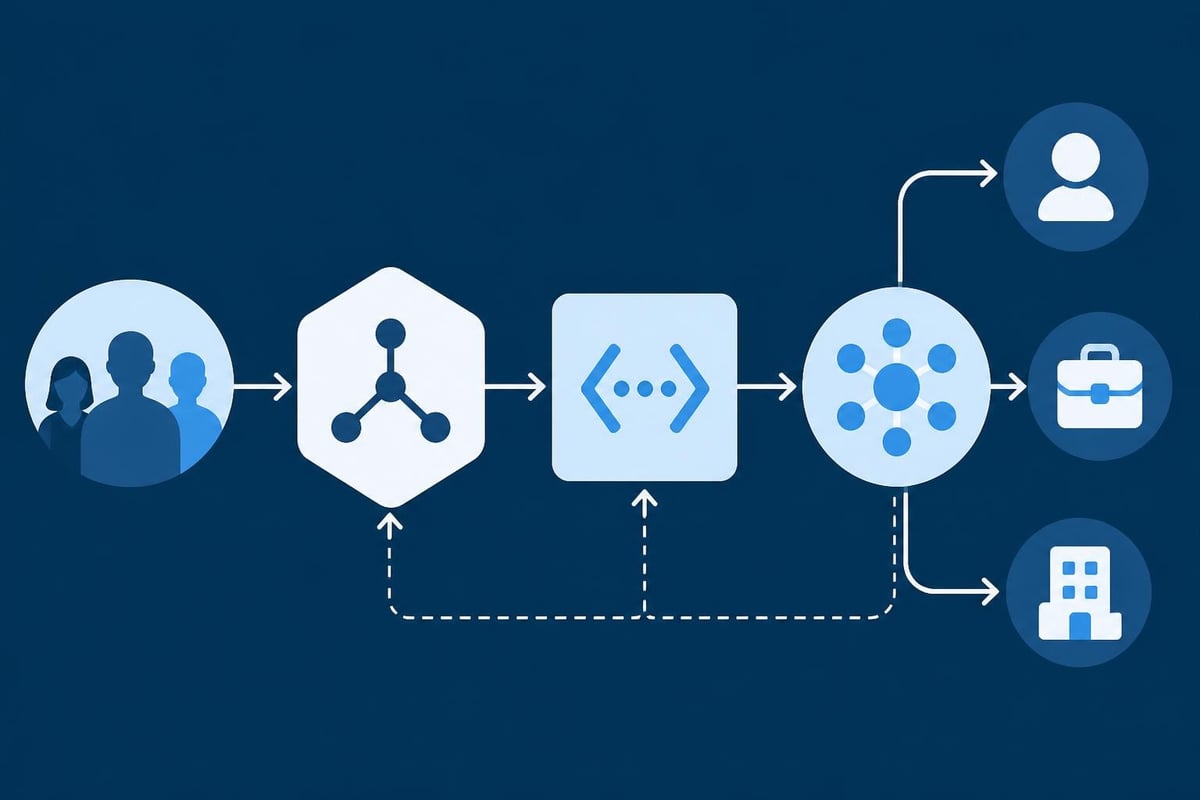
API Gateway provides centralized management for external and internal APIs, handling authentication, rate limiting, and request routing. For talent platforms exposing APIs to employer integrations, this service ensures consistent behavior and protects backend systems from abuse.
The tutorials page offers practical examples of implementing common integration patterns. These walkthroughs demonstrate connecting GCP services to third-party platforms through standard protocols including REST, gRPC, and message queues.
Pub/Sub enables asynchronous communication between services, decoupling systems that don't require immediate responses. When processing candidate verification checks that may take several minutes, Pub/Sub queues the requests while frontend applications remain responsive to user interactions.
For businesses seeking to expand their partner program or integrate with external recruitment tools, GCP's integration services provide the technical foundation for seamless data exchange while maintaining security boundaries.
Monitoring and Observability Best Practices
Operating production systems on GCP requires comprehensive visibility into performance, errors, and resource utilization. Cloud Monitoring aggregates metrics from all GCP services into customizable dashboards that surface critical information.
Key monitoring dimensions for talent platforms include:
- API response times for candidate search and matching operations
- Error rates across different service endpoints
- Database query performance and connection pool utilization
- ML model prediction latency and throughput
- Resource utilization (CPU, memory, disk) across compute instances
Cloud Logging centralizes application logs, system logs, and audit logs into a searchable repository. When investigating why a candidate matching algorithm produced unexpected results, developers can trace the complete request path through multiple services, examining logs at each processing stage.
Implementing Alerts and Incident Response
Alerting policies notify on-call personnel when metrics exceed defined thresholds or when error rates spike. Effective alerts balance sensitivity against noise, triggering only for conditions that require human intervention.
For AI platforms running machine learning operations, monitoring model performance metrics ensures prediction quality remains consistent. Sudden drops in matching accuracy might indicate data drift or system degradation requiring model retraining.
Cloud Trace provides distributed tracing capabilities that visualize request flows across microservices architectures. When optimizing candidate search performance, trace data reveals which service calls consume the most time and where optimization efforts should focus.
DevOps and Continuous Deployment on GCP
Modern development practices emphasize rapid iteration and automated deployment pipelines. Cloud Build provides native CI/CD capabilities that integrate directly with source code repositories including GitHub, GitLab, and Cloud Source Repositories.
Build triggers automatically execute when developers push code changes, running tests, building container images, and deploying updates to staging or production environments. This automation reduces deployment risks by ensuring consistent processes that don't depend on manual steps.
Typical deployment pipeline stages include:
- Code commit triggering automated builds
- Unit and integration test execution
- Container image creation and security scanning
- Deployment to staging environment for validation
- Automated or manual promotion to production
- Post-deployment smoke tests confirming functionality
Google Kubernetes Engine (GKE) orchestrates containerized applications across clusters of machines, automatically handling scaling, self-healing, and rolling updates. For talent platforms built on microservices architectures, GKE provides the operational foundation for managing dozens or hundreds of services.
Infrastructure changes deployed through Terraform or Cloud Deployment Manager version control and audit infrastructure modifications. When scaling compute resources for hiring managers during peak recruitment seasons, infrastructure code captures these changes in version control rather than relying on manual console adjustments.
Advanced GCP Features for Enterprise Platforms
As talent marketplaces mature, they often require enterprise features that support compliance, governance, and advanced security requirements. Organization policies enforce guardrails across all projects, preventing individual teams from accidentally deploying resources that violate corporate standards.
VPC Service Controls create security perimeters around sensitive resources, preventing data exfiltration even from compromised service accounts. For platforms handling candidate verification and fraud detection, these controls ensure that sensitive data never leaves designated security boundaries.
Resource hierarchies enable centralized billing management while delegating operational control to individual teams. A talent marketplace might separate billing for different business units or geographic regions while maintaining unified security policies and audit logging.
Binary Authorization ensures that only approved container images deploy to production environments. By requiring cryptographic signatures on all images, this feature prevents unauthorized code execution and supports compliance requirements around change management.
Global Deployment and Content Delivery
Cloud CDN caches static content at edge locations worldwide, reducing latency for users accessing the talent platform from different geographic regions. When employers browse candidate profiles including resumes and portfolios, CDN acceleration ensures fast page loads regardless of user location.
Cloud Load Balancing distributes traffic across multiple backend instances, providing high availability and automatic failover. For platforms experiencing rapid growth, load balancing enables gradual capacity expansion without service interruptions.
The Compute Engine API allows programmatic management of virtual machines, supporting sophisticated auto-scaling implementations that respond to custom metrics like pending candidate matches or employer search volume.
Real-World Implementation Considerations
Moving from proof-of-concept to production on GCP involves addressing numerous operational concerns beyond initial development. Disaster recovery planning establishes recovery time objectives (RTO) and recovery point objectives (RPO) that guide backup strategies and replication configurations.
Regular backup snapshots of Cloud SQL databases protect against data corruption or accidental deletion. For critical candidate and employer data, continuous replication to a secondary region provides geographic redundancy that supports business continuity during regional outages.
Performance testing under realistic load conditions identifies bottlenecks before they impact end users. Tools like JMeter or Locust can simulate thousands of concurrent users searching for candidates or submitting applications, revealing where infrastructure scaling becomes necessary.
Documentation maintained in parallel with infrastructure development accelerates onboarding for new team members and supports knowledge transfer. The blog resources demonstrate how comprehensive documentation benefits both internal teams and external users navigating platform capabilities.
Future-Proofing Your GCP Architecture
Technology platforms must evolve alongside business requirements and industry developments. Designing for extensibility rather than immediate needs creates flexibility for future enhancements without requiring complete architectural rewrites.
Adopting microservices architectures enables independent scaling and deployment of different platform components. The candidate matching service might require different compute resources than the employer messaging system, and microservices allow independent optimization.
Embracing serverless technologies like Cloud Functions and Cloud Run reduces operational overhead for components that don't require persistent compute resources. Event-driven architectures built on these services automatically scale to zero during idle periods, eliminating unnecessary costs.
Investing in observability from the beginning rather than adding it retroactively provides visibility into system behavior that informs optimization decisions. Comprehensive metrics, logs, and traces collected from day one create baselines for performance comparisons as the platform evolves.
The AI and machine learning landscape continues advancing rapidly. Platforms built on GCP's Vertex AI benefit from Google's ongoing investments in model improvement and new capabilities, automatically gaining access to better algorithms and more efficient inference options.
Successfully implementing GCP for AI-driven talent platforms requires balancing technical capabilities with business objectives, security requirements, and cost constraints. The platform's comprehensive service portfolio supports everything from basic web hosting to sophisticated machine learning operations, providing room for growth as marketplace demands evolve. If you're building recruitment technology that requires verified AI talent to implement these solutions effectively, Augmnt connects you with pre-vetted professionals who bring the cloud expertise and AI knowledge needed to build scalable, secure platforms on GCP's infrastructure.