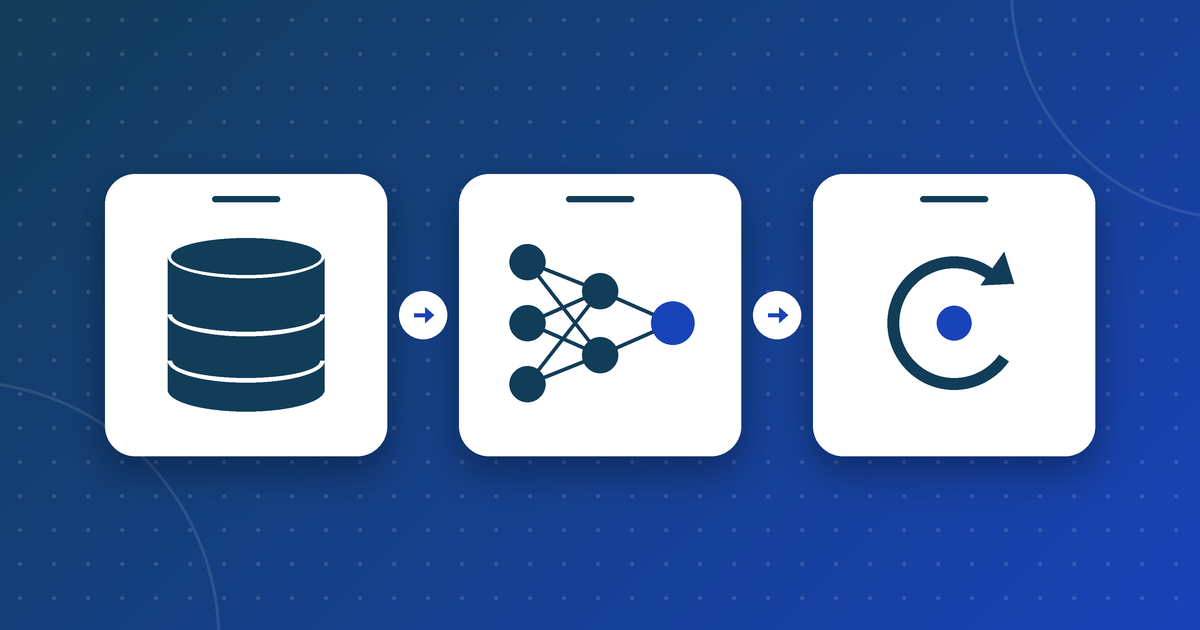
Data engineer, ML engineer or MLOps: which AI role do you need?
By Keara Garrett | Last updated: November 6, 2026
Which AI role should
you hire?
The answer depends on the outcome you need and where the work is currently stuck. If your data is scattered or unreliable, hire a data engineer. If the data is usable and you need a model built and evaluated, hire an ML engineer. If a working model needs to run reliably in production, hire an MLOps engineer.
“AI engineer” is a broad title that covers all three. Writing an AI engineer job description around that title alone tends to produce candidate profiles that do not match the work.
This guide compares a data engineer, a machine learning engineer, an MLOps engineer and a research role. Each one solves a different bottleneck, and the right choice follows from the outcome you define before you post the role.
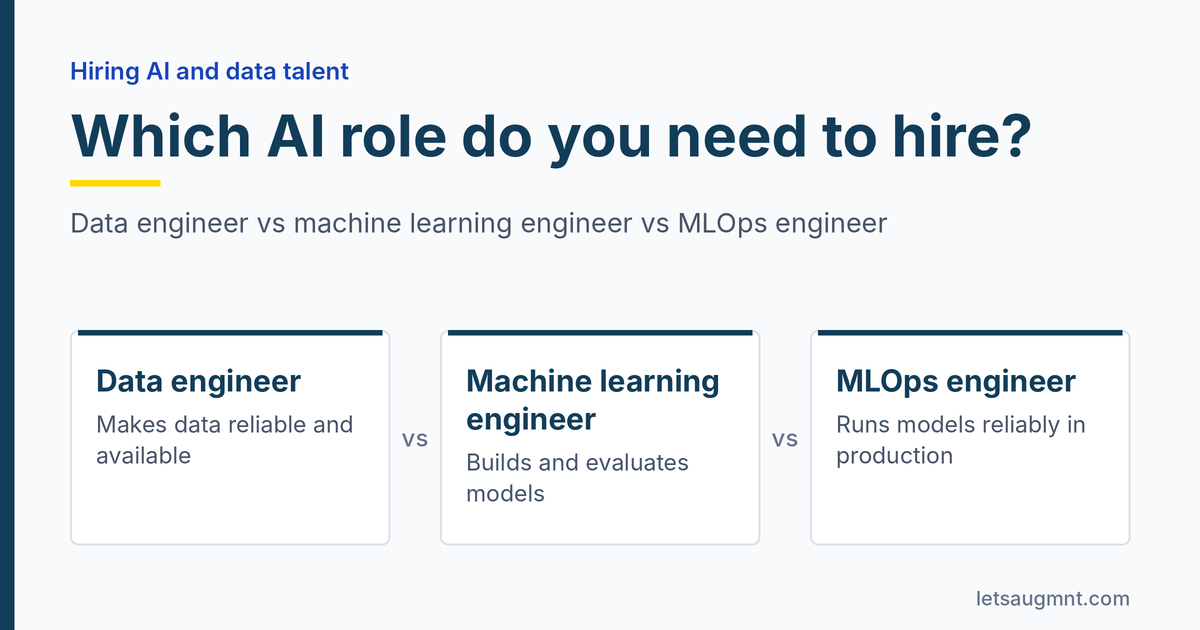
How do a data engineer, machine learning engineer and MLOps engineer differ?
Here is the data engineer vs machine learning engineer vs MLOps engineer comparison at a glance. The sections below explain each role in more detail.
Role | What it solves | Sign you need it | What to verify |
|---|---|---|---|
Data engineer | Makes data reliable and available | Data is scattered, unreliable or hard to refresh | Pipeline and warehousing work |
Machine learning engineer | Builds and evaluates models | Data is usable and there is a clear prediction goal | Model development and evaluation |
MLOps engineer | Runs models reliably in production | A pilot is moving into production use | Deployment, monitoring and retraining |
Research role | Answers open questions | No established approach exists yet | Published work and prototypes |
What does a data engineer do, and when should you hire one?
A data engineer builds and maintains the pipelines that move data from source systems into somewhere analysts and models can actually use. IBM describes data engineering as designing and building pipelines that turn raw data into unified datasets that keep their quality and reliability. The work centers on ingestion, transformation, warehousing and keeping that data accurate and available on a schedule people can rely on.
Signs the bottleneck is data access or quality rather than modelling:
Analysts spend most of their time cleaning exports by hand
Reports from two teams disagree on the same number
Data lives in source systems with no consolidated warehouse or lake
There is no reliable way to refresh a dataset without manual work
A previous model project stalled because training data could not be assembled
If several of these sound familiar, a data engineer is likely the right first hire. A modelling hire is unlikely to fix an upstream data problem. Google's engineers make a related point in their Rules of Machine Learning: most problems in ML work are engineering problems, and ML needs data. For more on this role, see our data engineer hiring guide.
What does a machine learning engineer do, and when do you need one?
A machine learning engineer selects, trains, tunes and evaluates models, then connects that work to software other people can call. Common tooling includes Python, PyTorch and TensorFlow. This role usually fits once your data is usable and you have a specific, measurable goal for what the model should predict or classify. Our machine learning engineer hiring guide goes deeper.
Skill | What it covers | Common misunderstanding |
|---|---|---|
Model development | Choosing an approach, training, tuning | That any ML engineer can also build your data pipelines |
Evaluation | Defining metrics, testing against holdout data | That accuracy alone proves business value |
Integration | Exposing the model to applications through APIs or batch jobs | That integration is the same as production operations |
Framework fluency | Python, PyTorch, TensorFlow | That framework names on a resume prove shipped work |
What does an MLOps engineer do, and when should you hire one?
MLOps applies the same discipline DevOps brought to software: versioning, automated release, monitoring and rollback. The difference is that it applies to models rather than application code. Google Cloud's MLOps documentation describes it as automation and monitoring at every step of building an ML system, including integration, testing, release, deployment and infrastructure management. The daily work covers deployment, monitoring for drift as real-world inputs change, and managing retraining cycles.
This role becomes necessary when a pilot moves into production use and someone has to keep it running.
Production readiness checklist:
Model artifacts and training data are versioned and reproducible
Deployment is automated, not a manual handoff
Prediction quality and input distributions are monitored after release
There is a defined retraining trigger and rollback path
If you cannot check all four, an MLOps engineer is likely the role you need next, ahead of another modelling hire.
When do you need a research role instead?
A research role fits problems where no established approach exists yet and the first deliverable is a finding, not a shipped feature. The US Bureau of Labor Statistics describes computer and information research scientists as people who design new uses for technology and study complex computing problems, and who publish papers and present at conferences. The timeline is open-ended by design.
Engineering roles are measured by whether something works in production. Research is measured by whether a question gets answered. Most teams with a defined business outcome need an engineering hire first.
Which requests ask for the wrong role?
Role requests often start from the solution someone has in mind rather than the problem they have. They can also begin as a copied job description or a second-hand brief, which means technical detail gets lost along the way. These mismatches are worth checking before you post:
Asking for an ML engineer when the pipelines are the problem. If data is unreliable, undocumented or has no owner, modelling work stalls. A data engineer is the better fit.
Asking for an LLM or agent specialist when a prototype already exists. What is often missing is testing, monitoring, cost control and a path to production. Those are evaluation and MLOps skills.
Asking for a senior data scientist when the need is trusted metrics. Clean, consistent reporting data is often an analytics engineering job rather than a new model.
Asking for one person to do everything. A list that covers architecture, pipelines, modelling, cloud and stakeholder management may be two or three roles, or one role plus a short specialist engagement.
Asking for a long-term hire when the need is a focused engagement. A three-month build to unblock the team, followed by a hand-off, may fit better.
A quick test: for each requirement, ask what problem it solves. Move anything that does not point at the real blocker to nice-to-have. Expect the title and skills list to get shorter and more specific.
In what order should you hire these roles?
A common sequence is data, then modelling, then operations. That is a pattern, not a rule. The right order depends on your data maturity and the outcome you need.
Data foundation. Pipelines, warehousing, reliability.
Modelling. Building and evaluating against a defined goal.
Operations. Deployment, monitoring, retraining.
Teams with a mature warehouse can skip straight to phase two. A team deploying a vendor model may need phase three without phase two at all. Contract consultants can fit well here because each phase has a definable scope and end point. That lets you cover a specific skill gap without committing to permanent headcount.
How do you scope an AI engineering role before you search?
Write the business outcome and a definition of done before you write the AI engineer job description. “Reduce manual invoice review time” is a scope. “Hire an AI engineer” is not. Be specific about the end state and honest about the current one.
Then name the environment. Which cloud platform, which warehouse, which orchestration tool. Ask for deployment experience in that context rather than a list of frameworks. Tool names are easy to list on a resume without having shipped the work.
Questions for the technical intake:
What business outcome does this work produce, and how will we know it worked?
What state is our data in today, and who maintains it?
Which cloud platform, warehouse and orchestration tools will the consultant work in? Is this a build phase, a production phase, or both? Has this consultant deployed and maintained something comparable, and where? Is this a contract engagement with a defined end, or an ongoing need?
What should you verify for each role?
Match the skills check to the role. Verify pipeline and warehousing work for a data engineer. Verify model development and evaluation for an ML engineer. Verify production operations, monitoring and retraining for MLOps. A generic technical screen may not test any of these well.
Four checks matter: resume verification, skills verification, work eligibility and background checks. Work eligibility and background check rules differ by country, and by province or state. Confirm which rules apply to your situation before the screen begins.
Augmnt is a marketplace of verified AI, data and tech consultants. We run these checks before candidate profiles are shared with you. No check removes all risk, so ask what each one covers for the role you are hiring. For a fuller look at how verification works, read our guide to hiring a verified AI consultant.
What are the key takeaways?
Define the business outcome and a definition of done before you choose a job title.
Match the role to where the work is stuck: data access, model development, or production reliability.
Check your request for common mismatches, such as asking for modelling when the real blocker is data.
A data, modelling, operations sequence is common but depends on your data maturity, not on title trends.
Verify the skills that fit the role, and confirm which work eligibility rules apply.
Frequently asked questions
Which is better, data engineering or machine learning?
Neither is better. They solve different problems. Data engineering makes data reliable and available. Machine learning engineering builds and evaluates models on top of that data. The right one depends on where your project is stuck. If the data is the blocker, start with a data engineer.
Is MLOps harder than DevOps?
Not necessarily harder, but different. MLOps builds on DevOps practices such as automated testing and delivery, then adds work that is specific to models, like tracking data and model versions, monitoring for drift and managing retraining. Google Cloud's MLOps documentation notes that ML systems share many steps with other software but differ in a few notable ways. When you verify an MLOps candidate, ask about the model-specific work, not only the DevOps tooling.
Can one person cover data engineering, ML engineering and MLOps?
Sometimes, for a small and well-defined project. But a list that asks for all three is often two or three roles, or one role plus a short specialist engagement. Define the outcome first, then ask each candidate for specific examples of work they have shipped in the area that matters most.
Scoping an AI or data role right now? Contact us and tell us what you need. If you want our team to source, verify and deliver onshore consultants in the US and Canada, see our staff augmentation service.
Sources
IBM, What is data engineering? (accessed November 6, 2026)
Google, Rules of Machine Learning: Best Practices for ML Engineering (accessed November 6, 2026)
Google Cloud, MLOps: Continuous delivery and automation pipelines in machine learning (last reviewed August 28, 2024; accessed November 6, 2026)
US Bureau of Labor Statistics, Computer and Information Research Scientists, Occupational Outlook Handbook (accessed November 6, 2026)