ATS for Staffing Agencies: Features & Implementation Guide
Staffing agencies operate in a fundamentally different environment than traditional corporate recruiting teams. While in-house recruiters typically fill a handful of positions per quarter, staffing professionals manage hundreds of active candidates, dozens of client relationships, and constant placement cycles simultaneously. This operational reality demands specialized technology solutions. An applicant tracking system designed for corporate hiring falls short when faced with the unique demands of staffing agencies, which require tools that support high-volume workflows, multi-client management, and the complex relationships between candidates, job orders, and client organizations.
Understanding the Unique Requirements of Staffing Agency ATS
The staffing industry presents distinctive challenges that generic recruiting software cannot adequately address. Staffing agencies don't just fill positions; they build and maintain talent pools that serve multiple clients across various industries and job categories.
Volume and Velocity Considerations
Staffing agencies process candidate applications at scales that dwarf typical corporate recruiting operations. A mid-sized agency might review thousands of resumes monthly while simultaneously managing hundreds of active placements. This volume requires specialized features that handle high-throughput workflows effectively.
Key volume-related capabilities include:
- Bulk resume parsing and candidate import functionality
- Automated initial screening and qualification workflows
- Rapid candidate search and matching across multiple job orders
- High-capacity database architecture that maintains performance with large talent pools
The velocity of staffing operations demands instant access to candidate information. When a client calls with an urgent opening, recruiters need to identify qualified candidates within minutes, not hours.
Multi-Client Relationship Management
Unlike corporate recruiters who work for a single employer, staffing professionals juggle relationships with numerous client companies simultaneously. Each client relationship involves unique requirements, compliance standards, billing arrangements, and communication preferences.
An effective ats for staffing agencies must integrate customer relationship management (CRM) functionality alongside traditional applicant tracking. This dual capability allows recruiters to manage both sides of their marketplace: the talent supply and the client demand.
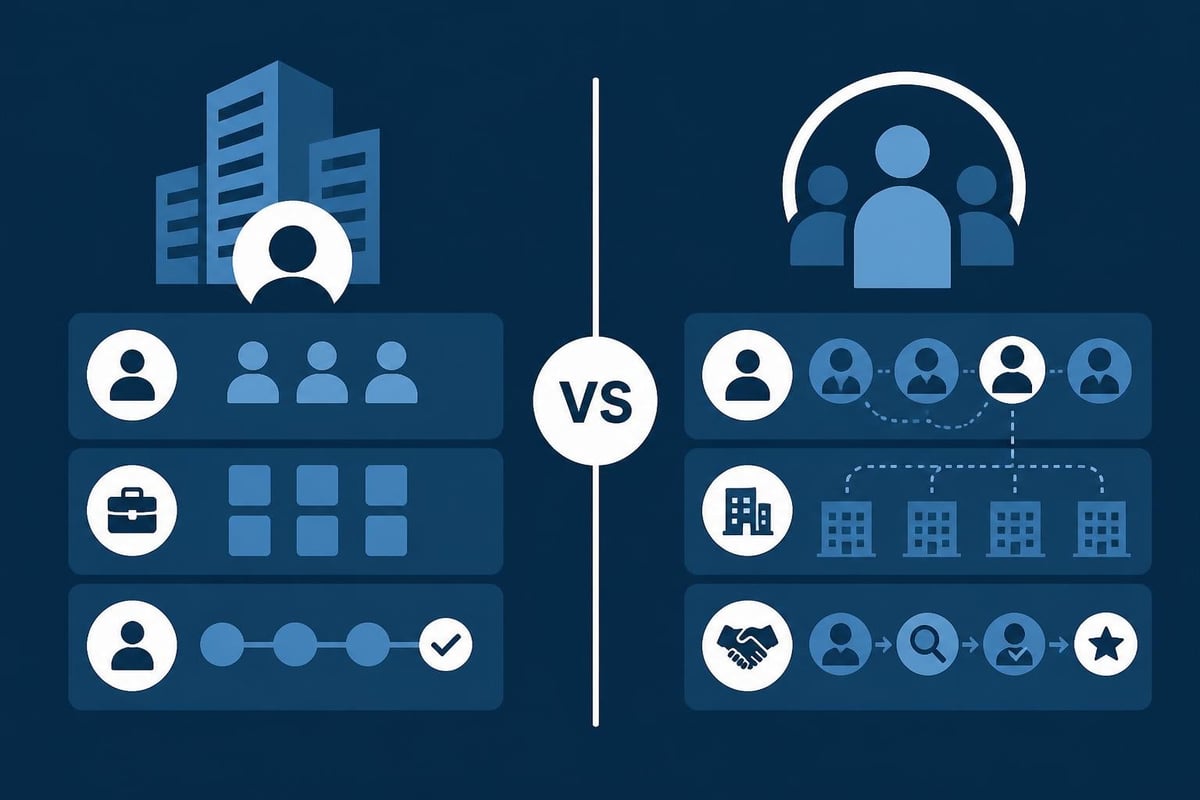
| Traditional ATS | Staffing Agency ATS |
|---|---|
| Tracks candidates for internal positions | Manages candidates for multiple external clients |
| Single employer focus | Multi-client portfolio management |
| Linear hiring workflows | Complex, reusable candidate relationships |
| Position-centric data model | Candidate-centric with flexible assignment |
Essential Features for Staffing Agency Success
The right technology stack transforms how staffing agencies operate, enabling recruiters to work faster, smarter, and with greater precision. Modern ats for staffing agencies incorporates features specifically designed for the industry's operational patterns.
Intelligent Candidate Matching and Search
Staffing recruiters spend significant time matching candidates to job orders. Advanced search capabilities become business-critical tools rather than nice-to-have features.
Effective matching systems provide:
- Boolean search with nested logic and field-specific operators
- Skills-based matching with synonym recognition
- Geographic radius search for location-sensitive placements
- Availability filtering for contract and temporary positions
- Certification and credential tracking with expiration alerts
The evolution of recruitment platforms in 2026 has introduced AI-powered matching that goes beyond keyword searches. These systems analyze job requirements holistically and identify candidates whose experience profiles align with client needs, even when exact keyword matches don't exist.
Workflow Automation and Process Efficiency
Staffing agencies thrive on process efficiency. Every minute saved on administrative tasks translates directly to more time for relationship building and business development.
Automation opportunities span the entire recruitment lifecycle. Resume parsing eliminates manual data entry when new candidates enter the system. Automated email sequences keep candidates engaged throughout the placement process. Status update triggers notify clients when key milestones occur.
Modern platforms leverage AI to streamline traditionally manual processes. Research into multi-layer AI frameworks for applicant tracking demonstrates how automation can enhance resume screening accuracy while reducing time-to-shortlist by significant margins.
Compliance and Credentialing Management
Staffing agencies bear significant compliance responsibilities, particularly in regulated industries like healthcare, education, and finance. Tracking certifications, licenses, background checks, and drug screenings becomes a critical operational function.
A robust ats for staffing agencies includes compliance modules that automate credential tracking and renewal reminders. These systems flag candidates whose certifications are approaching expiration and prevent submission of non-compliant candidates to client job orders.
Integration Capabilities That Extend Platform Value
No recruiting technology operates in isolation. Staffing agencies rely on ecosystems of interconnected tools that handle payroll, onboarding, skills assessment, background screening, and client communication.
Core Integration Categories
Financial and payroll systems synchronize placement data with billing and compensation processes. When a candidate accepts an assignment, that information flows automatically to payroll systems without manual data re-entry.
Background screening providers connect directly to ATS workflows, initiating checks automatically when candidates reach specific pipeline stages. Results populate directly into candidate records with proper documentation and audit trails.
Skills assessment platforms validate candidate capabilities before submission to clients. Modern ATS integration capabilities enable seamless data exchange between recruiting systems and specialized assessment tools, creating comprehensive candidate profiles that combine self-reported experience with verified skills.
Communication tools including email platforms, SMS providers, and video interviewing solutions connect to ATS systems to maintain complete interaction histories. Every touchpoint with candidates and clients becomes part of a unified record.
API Architecture and Data Exchange
Modern staffing agencies evaluate ATS platforms based on their integration flexibility. Open API architectures allow agencies to build custom connections with proprietary or industry-specific tools.
The challenge of integrating data from multiple hiring systems reveals both opportunities and limitations in current recruitment technology. Organizations that successfully unify data across platforms gain actionable insights into their recruitment performance and candidate pipeline health.

Selecting the Right ATS for Your Staffing Agency
The market offers dozens of applicant tracking systems, each positioning itself as ideal for staffing operations. Distinguishing genuine capability from marketing claims requires structured evaluation.
Assessment Framework
Begin by documenting your agency's specific operational requirements. Different staffing models (temporary, temp-to-perm, direct hire, executive search) create different technology needs.
Evaluation criteria should include:
- User capacity and licensing model: Per-user pricing versus unlimited users
- Database scalability: Maximum candidate records and performance at scale
- Mobile functionality: Recruiter access from smartphones and tablets
- Reporting and analytics: Standard reports and custom dashboard creation
- Implementation timeline: Typical deployment duration and data migration support
- Training resources: Onboarding programs and ongoing education
Request demonstrations using your actual job orders and candidate profiles. Generic demos showcase features but don't reveal how the system handles your specific use cases.
Build vs. Buy Considerations
Some large staffing agencies consider building custom ATS platforms tailored precisely to their processes. This approach offers maximum flexibility but requires substantial technical resources and ongoing development commitment.
| Build Custom Solution | Purchase Commercial ATS |
|---|---|
| Perfect fit to current processes | Immediate availability |
| Complete control over features | Proven functionality |
| Significant development cost | Predictable subscription pricing |
| Ongoing maintenance burden | Vendor-managed updates |
| Extended implementation timeline | Rapid deployment |
For most agencies, commercial ats for staffing agencies solutions provide better value. The specialized features required for staffing operations already exist in mature platforms, and vendors continuously enhance their products based on industry feedback.
Maximizing ROI Through Strategic Implementation
Technology purchases fail when implementation receives insufficient attention. The transition from legacy systems (or spreadsheets) to modern ATS platforms requires change management, not just technical configuration.
Data Migration Strategy
Your existing candidate database represents accumulated business value. Migrating this data cleanly into a new system ensures continuity and protects that investment.
- Audit existing data quality before migration
- Standardize formats for consistent field mapping
- Prioritize active candidates for initial migration phases
- Validate migrated data through spot-checking and reporting
- Archive historical records appropriately for compliance
Plan for iterative migration rather than single-event cutover. Moving active candidates and recent placements first allows your team to begin working in the new system while historical data migrates in subsequent phases.
User Adoption and Training
The most capable ATS delivers zero value if recruiters don't use it effectively. User adoption determines implementation success more than feature counts or technical specifications.
Effective training programs include:
- Role-specific instruction for recruiters, account managers, and administrators
- Hands-on practice with realistic scenarios
- Quick reference guides for common tasks
- Ongoing coaching sessions post-launch
- Power user development for peer support
Consider phased rollout strategies that introduce core functionality first, then layer in advanced features as user confidence grows. Overwhelming teams with every capability simultaneously creates confusion and resistance.
Performance Metrics and Continuous Improvement
Establish baseline metrics before ATS implementation to measure impact objectively. Track time-to-fill, submittals-per-placement, candidate redeployment rates, and recruiter productivity.
Modern analytics capabilities reveal patterns invisible in manual processes. Which sourcing channels produce the highest-quality candidates? Which clients have the fastest hiring cycles? What skills are most frequently requested but hardest to source?
Enhanced transparency in recruitment decisions benefits both agencies and candidates. Systems that provide clear rationale for candidate selection or rejection improve fairness and help recruiters refine their matching criteria.

Advanced Capabilities Shaping the Future
The ats for staffing agencies category continues evolving rapidly as artificial intelligence, machine learning, and automation technologies mature. Forward-thinking agencies evaluate platforms based on their trajectory, not just current feature sets.
AI-Powered Candidate Sourcing
Passive candidate sourcing consumes significant recruiter time. AI-powered tools automate the discovery of qualified candidates who aren't actively seeking new positions but match client requirements.
These systems scan professional networks, industry forums, and public profiles to identify potential candidates. They analyze career progression patterns, skill combinations, and industry experience to predict candidate suitability for specific roles.
Platforms like Augmnt ATS combine verified matching with candidate fraud detection, addressing a critical challenge for staffing agencies. Resume fraud and credential misrepresentation create liability risks and damage client relationships when unqualified candidates are placed.
Resume Optimization and Candidate Presentation
Staffing agencies increasingly leverage technology to enhance candidate presentation. AI-assisted resume tailoring systems use multi-source retrieval to customize candidate profiles for specific job descriptions, highlighting relevant experience while maintaining accuracy.
These tools help recruiters present candidates more effectively without manual reformatting. The technology identifies which aspects of a candidate's background align most closely with client requirements and emphasizes those elements in submission materials.
Predictive Analytics for Placement Success
Machine learning models analyze historical placement data to predict which candidates are most likely to succeed in specific roles or client environments. These systems consider factors beyond skills and experience, including work style preferences, commute tolerance, and career trajectory alignment.
Predictive models also identify placement risk factors. Candidates who have quickly departed previous assignments might represent higher risk for long-term placements, while those with stable work histories signal reliability.
Mobile-First Recruiting in the Modern Era
Staffing recruiters rarely work exclusively from desks. Client meetings, candidate interviews, and industry events keep them mobile. Modern ats for staffing agencies must support full functionality from smartphones and tablets.
Mobile Capabilities That Matter
Candidate search and matching functionality needs to work seamlessly on mobile devices. Recruiters at networking events should be able to search their database instantly when they meet promising candidates.
Communication tools including text messaging, email, and call logging must integrate with mobile ATS apps. Every interaction should be captured automatically, regardless of the device used.
Job order management allows account managers to create and update client openings from anywhere. When clients call with urgent needs, immediate action becomes possible without returning to the office.
Approval workflows enable managers to review and approve candidate submissions remotely. Placement processes shouldn't stall because decision-makers are traveling.
Native Apps vs. Responsive Web
Evaluate whether platforms offer native mobile applications or rely on responsive web design. Native apps typically provide better performance and offline functionality, while responsive web interfaces offer universal access without app installation.
The optimal solution depends on your team's working patterns. Recruiters who frequently work in areas with poor connectivity benefit from native apps with offline capabilities. Teams with reliable internet access may prefer the simplicity of responsive web platforms that require no separate app management.
Security and Data Protection Considerations
Staffing agencies manage highly sensitive information including candidate social security numbers, salary histories, background check results, and client confidential hiring plans. Data security isn't optional; it's foundational.
Essential Security Features
Role-based access controls limit data visibility to appropriate team members. Recruiters should access only the candidates and clients they manage, while administrators maintain broader system access.
Encryption standards for data at rest and in transit protect information from unauthorized access. Verify that prospective ATS platforms employ current encryption protocols and maintain security certifications.
Audit logging tracks every system action, creating accountability and supporting compliance investigations. Complete audit trails document who accessed which records and what changes they made.
Backup and disaster recovery procedures ensure business continuity even when technical failures occur. Understand vendors' backup frequencies, retention periods, and recovery time objectives.
Compliance With Employment Regulations
Employment law complexity varies by jurisdiction, industry, and job category. ATS platforms designed for staffing agencies incorporate compliance features that help navigate this regulatory landscape.
EEOC reporting requirements demand specific data collection and reporting capabilities. GDPR and similar privacy regulations impose restrictions on how candidate data can be stored, processed, and shared.
For agencies placing candidates in regulated industries, compliance tracking becomes even more critical. Healthcare staffing requires meticulous credential verification and license tracking, while financial services placements demand background screening and regulatory clearances.
Cost Structures and Budget Planning
The financial investment in ats for staffing agencies extends beyond software subscription fees. Comprehensive budget planning accounts for implementation costs, training expenses, integration development, and ongoing support.
Pricing Models Explained
Per-user subscriptions charge monthly or annual fees based on active user counts. This model scales naturally with agency growth but can become expensive for larger teams.
Tiered feature packages offer basic, professional, and enterprise levels with progressively more capabilities. Agencies start with entry-level packages and upgrade as needs evolve.
Usage-based pricing charges based on active job orders, candidate database size, or monthly placements. This model aligns costs with business activity but creates variable monthly expenses.
Total Cost of Ownership Analysis
| Cost Category | Year 1 | Years 2-3 | Ongoing |
|---|---|---|---|
| Software licenses | $15,000 | $15,000/yr | $15,000/yr |
| Implementation services | $8,000 | - | - |
| Data migration | $5,000 | - | - |
| Training | $3,000 | $1,000/yr | $1,000/yr |
| Integration development | $4,000 | $2,000/yr | $1,000/yr |
| Total | $35,000 | $18,000/yr | $17,000/yr |
Calculate expected efficiency gains against these costs. If the ATS enables each recruiter to make two additional placements annually, and average placement fees are $8,000, a five-person team generates $80,000 in additional revenue. The system pays for itself quickly.
Vendor Selection and Partnership Approach
Choosing an ATS vendor establishes a long-term partnership that significantly impacts your agency's operations. Thorough vendor evaluation prevents costly mistakes and implementation failures.
Questions for Prospective Vendors
How frequently do you release updates? Regular enhancement cycles indicate active development and vendor commitment to product improvement.
What is your customer retention rate? High retention suggests customer satisfaction and product-market fit.
Can you provide references from similar staffing agencies? Speak with agencies of comparable size and focus to understand real-world experiences.
What support channels do you offer? Phone, email, chat, and knowledge base resources provide different levels of assistance.
How do you handle feature requests? Understanding the product roadmap process reveals how responsive vendors are to customer needs.
Implementation Partnership Structure
Successful implementations involve collaborative partnerships between agency teams and vendor implementation specialists. Clarify roles, responsibilities, and timelines before project kickoff.
Identify an internal project champion who coordinates vendor interactions and drives internal adoption. This person becomes the bridge between technical configuration and operational requirements.
Establish regular check-in meetings throughout implementation to address issues promptly and maintain momentum. Weekly status calls during active implementation phases keep projects on track.
Industry-Specific Considerations
Different staffing verticals create unique ATS requirements. Healthcare staffing demands comprehensive credentialing management. IT staffing needs technical skills taxonomies. Light industrial staffing requires high-volume onboarding tools.
Healthcare Staffing Technology Needs
Healthcare placements involve extensive compliance requirements including license verification, continuing education tracking, immunization records, and specialty certifications.
Specialized healthcare staffing platforms integrate clinical credentialing workflows directly into ATS functionality, streamlining the complex verification processes required before candidate submission.
Technology and IT Staffing Requirements
Technology staffing agencies work with rapidly evolving skill sets and highly competitive talent markets. ATS platforms for this vertical need robust skills taxonomies that accommodate emerging technologies.
Integration with technical assessment platforms validates candidate capabilities beyond resume claims. Coding challenges, system architecture exercises, and technical interviews become part of the candidate record.
Executive Search Differentiation
Executive search firms operate with smaller candidate volumes but much longer relationship cycles. ATS requirements emphasize relationship management over high-volume workflow automation.
Detailed interaction tracking, relationship mapping, and long-term candidate engagement tools matter more than rapid resume parsing or bulk email capabilities.
Modern staffing agencies require specialized technology that supports their unique operational model. The right ats for staffing agencies transforms recruiter productivity, strengthens client relationships, and creates competitive advantages through faster placements and higher-quality candidate matching. As artificial intelligence continues reshaping recruitment, platforms that combine automation with verified candidate data deliver the greatest value. Augmnt provides exactly this combination, connecting businesses with verified AI professionals through intelligent matching and comprehensive fraud detection. Explore how Augmnt's approach to candidate verification and skills validation can enhance your staffing operations and protect your client relationships.