
AI Consulting Firms: Guide to Strategic Implementation
Businesses across every sector face mounting pressure to integrate artificial intelligence into their operations, yet many lack the internal expertise to do so effectively. This gap has fueled explosive growth in the AI consulting industry, where specialized firms bridge the divide between technological possibility and practical implementation. Understanding what these firms offer, how to evaluate them, and when to engage their services has become essential for organizations seeking competitive advantage in an AI-driven marketplace.
The Evolving Landscape of AI Consulting Services
The AI consulting service market has experienced remarkable expansion over the past several years, driven by increasing enterprise demand for machine learning capabilities, natural language processing applications, and intelligent automation systems. AI consulting firms now operate across a spectrum that ranges from strategic planning to hands-on technical implementation.
These organizations typically serve multiple functions within client engagements. They assess current technological infrastructure, identify opportunities for AI integration, develop custom solutions, and provide ongoing support as systems mature. The most effective firms combine technical depth with industry-specific knowledge, enabling them to translate abstract AI concepts into concrete business value.
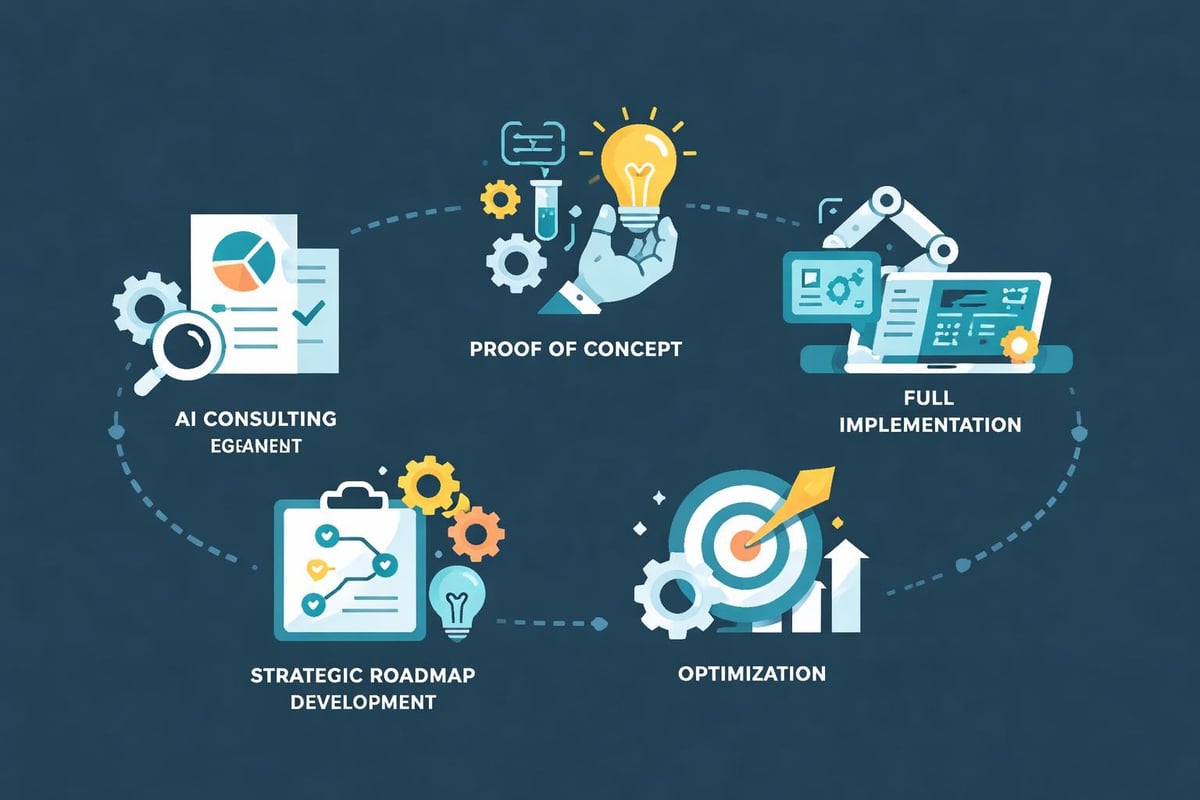
Core Service Offerings in 2026
Modern AI consulting firms have expanded far beyond simple advisory services. Their portfolios now encompass several distinct categories:
Strategic AI Planning and Assessment
- Technology readiness evaluations
- Use case identification and prioritization
- ROI modeling and business case development
- Data maturity assessments
- Competitive landscape analysis
Custom AI Development and Implementation
- Machine learning model creation
- Natural language processing solutions
- Computer vision applications
- Predictive analytics systems
- Recommendation engines
Infrastructure and Integration Services
- Cloud architecture design
- MLOps pipeline development
- Legacy system integration
- Data pipeline construction
- API development and management
The breadth of these offerings reflects how AI has permeated virtually every business function, from customer service automation to supply chain optimization.
Selecting the Right AI Consulting Partner
Choosing an appropriate consulting partner represents one of the most critical decisions in an AI transformation journey. The wrong choice can result in wasted resources, delayed timelines, and failed implementations that create organizational skepticism toward future AI initiatives.
| Evaluation Criteria | Key Questions | Red Flags |
|---|---|---|
| Technical Expertise | Do they have demonstrated experience with relevant AI technologies? | Vague technical descriptions, no case studies |
| Industry Knowledge | Have they solved similar problems in your sector? | Generic solutions, lack of domain understanding |
| Implementation Track Record | Can they show completed projects with measurable outcomes? | Focus only on strategy, no production deployments |
| Team Composition | Who will actually do the work? | Junior staff after sales, high turnover rates |
| Cultural Fit | Do their values align with your organization? | Rigid methodologies, poor communication |
Research from industry analysts highlights that talent scarcity remains one of the primary challenges facing organizations seeking AI expertise. This shortage has created significant variation in consulting quality, making due diligence essential.
The Build vs. Buy Decision
Organizations must determine whether to develop internal AI capabilities or rely on external consultants. This decision involves several considerations beyond simple cost comparison.
Building internal teams offers long-term knowledge retention and cultural alignment. However, it requires significant time investment, competitive compensation packages, and ongoing training to keep pace with rapidly evolving technologies. For many mid-sized companies, attracting top-tier AI talent remains prohibitively difficult.
External consulting provides immediate access to specialized expertise across multiple disciplines. Consultants bring cross-industry insights and established methodologies that accelerate time-to-value. The trade-off involves dependency on outside resources and potential knowledge transfer challenges when engagements conclude.
Many organizations adopt hybrid approaches, using consultants for initial implementation while simultaneously developing internal capabilities. This strategy combines external expertise with long-term sustainability, though it requires careful coordination to succeed.
Implementation Approaches That Deliver Results
The most successful AI consulting engagements share common characteristics that differentiate them from projects that stall or fail to deliver promised value. Understanding these patterns helps organizations structure their consulting relationships for optimal outcomes.
Effective consultants begin with narrowly scoped proof-of-concept projects that demonstrate value quickly. Rather than attempting comprehensive transformation from day one, they identify high-impact use cases that can be implemented within three to six months. This approach builds organizational confidence while generating measurable ROI that funds subsequent initiatives.
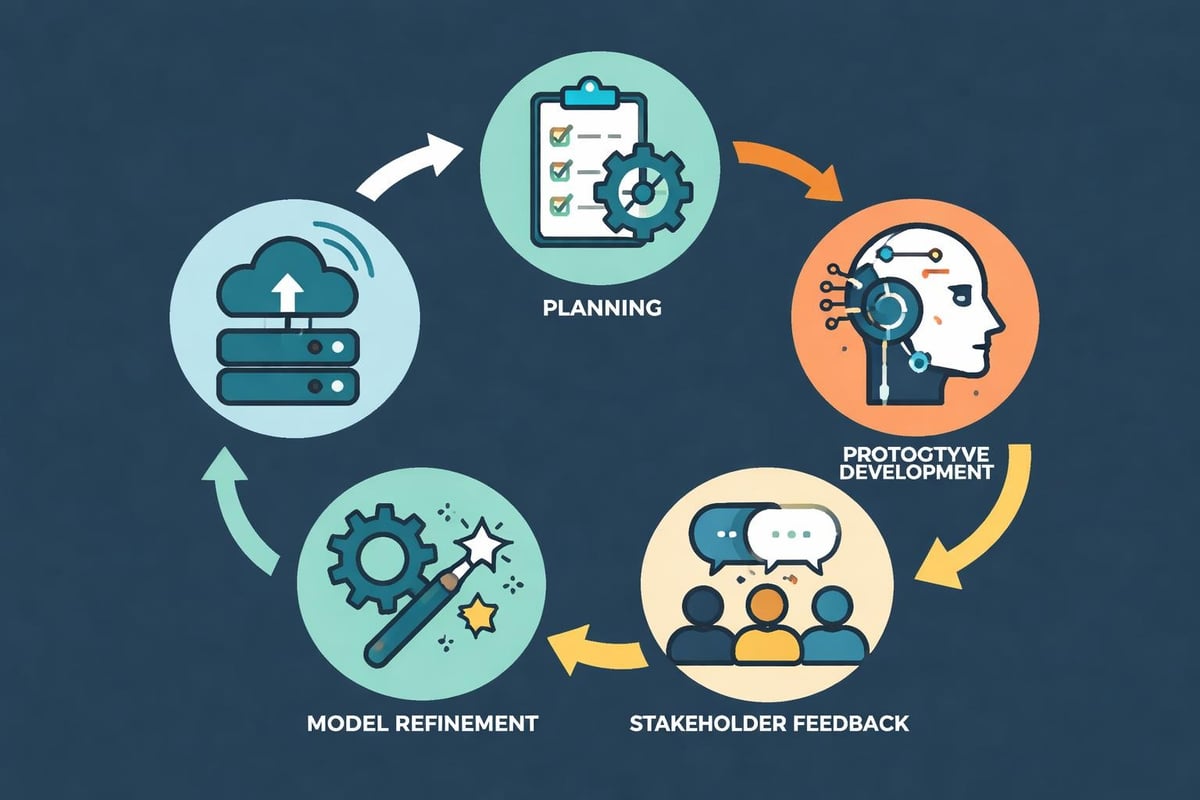
Agile Development and Iteration
Modern AI consulting firms have largely abandoned traditional waterfall methodologies in favor of agile approaches that emphasize continuous delivery and refinement.
- Sprint Planning: Define specific deliverables for two-week development cycles
- Rapid Prototyping: Create working models using subset data
- Stakeholder Review: Gather feedback from end users and business owners
- Model Refinement: Adjust algorithms based on performance metrics
- Incremental Deployment: Roll out improvements without disrupting operations
- Performance Monitoring: Track KPIs and user adoption continuously
This iterative process allows organizations to course-correct based on real-world results rather than theoretical assumptions. It also helps manage the inherent uncertainty in AI projects, where initial hypotheses about model performance may not survive contact with production data.
Pricing Models and Value Demonstration
The financial structure of AI consulting engagements has evolved significantly as the industry has matured. Redefining value in the age of AI requires consultants to demonstrate clear ROI rather than simply billing hours.
Traditional time-and-materials contracts remain common for exploratory work and ongoing support. However, many firms now offer alternative pricing structures designed to align consultant incentives with client outcomes.
Fixed-Price Project Agreements
These work well for clearly defined deliverables like specific model development or system integration. Clients gain budget certainty, while consultants assume performance risk. Success requires detailed scoping and change management processes.
Retainer Arrangements
Monthly retainers provide ongoing access to consulting resources for strategy, optimization, and troubleshooting. This model suits organizations running multiple AI initiatives that need consistent expert guidance without full-time hires.
Performance-Based Compensation
Some ai consulting firms tie portions of their fees to measurable business outcomes like cost reduction, revenue increase, or efficiency gains. While attractive in theory, these arrangements require sophisticated measurement frameworks and longer engagement timelines.
| Pricing Model | Best For | Typical Range | Risk Distribution |
|---|---|---|---|
| Hourly Billing | Exploration, ongoing support | $200-$500/hour | Client bears risk |
| Fixed Project | Defined deliverables | $50K-$500K+ | Consultant bears risk |
| Monthly Retainer | Continuous engagement | $15K-$100K/month | Shared risk |
| Performance-Based | Clear ROI metrics | Variable with bonuses | Heavily shared |
Organizations should match pricing structures to project characteristics and risk tolerance. Early-stage exploration often justifies hourly billing, while production implementations benefit from fixed-price or performance-based arrangements.
The Human Element in AI Transformation
Despite the technological focus of AI initiatives, human factors ultimately determine project success or failure. AI consulting firms must address organizational change management, skill development, and cultural adaptation alongside technical implementation.
Successful consultants invest significant effort in stakeholder alignment before writing any code. They conduct workshops that build shared understanding of AI capabilities and limitations. They identify champions within client organizations who can advocate for the initiative when challenges arise. They create communication plans that keep leadership informed without overwhelming them with technical details.
Training and knowledge transfer separate exceptional consulting engagements from mediocre ones. The best firms treat client education as a core deliverable, not an afterthought. They conduct hands-on training sessions, create documentation tailored to different user roles, and establish support structures that enable self-sufficiency.
Building Internal AI Capabilities
Organizations increasingly recognize that sustainable AI adoption requires developing internal expertise rather than permanent dependency on external consultants. Forward-thinking ai consulting firms actively support this goal through structured knowledge transfer programs.
- Embedded Learning: Consultants work alongside client teams, explaining decisions and teaching techniques in real-time
- Documentation Standards: Comprehensive technical documentation and runbooks enable future maintenance
- Train-the-Trainer Programs: Client employees learn to educate others, multiplying knowledge impact
- Transition Planning: Gradual handoff of responsibilities with consultant backup during initial independent operation
This collaborative approach benefits both parties. Clients gain lasting capabilities that justify consulting investment, while consultants build reputations that generate referrals and repeat business.
Industry-Specific Applications and Expertise
The effectiveness of AI consulting varies considerably based on industry context. Generic approaches rarely deliver optimal results compared to solutions designed for specific sector challenges and regulatory environments.
Healthcare and Life Sciences
AI consulting in healthcare addresses clinical decision support, drug discovery acceleration, patient outcome prediction, and administrative automation. Consultants must navigate HIPAA compliance, FDA regulations, and clinical validation requirements while delivering solutions that integrate with complex electronic health record systems.
Financial Services
Banking and insurance applications focus on fraud detection, risk assessment, algorithmic trading, and customer personalization. Regulatory compliance, model interpretability, and real-time performance requirements create unique technical challenges that demand specialized expertise.
Manufacturing and Supply Chain
Industrial AI applications include predictive maintenance, quality control automation, demand forecasting, and logistics optimization. Consultants must understand operational technology environments, integrate with IoT sensor networks, and deliver solutions that function reliably in production settings.
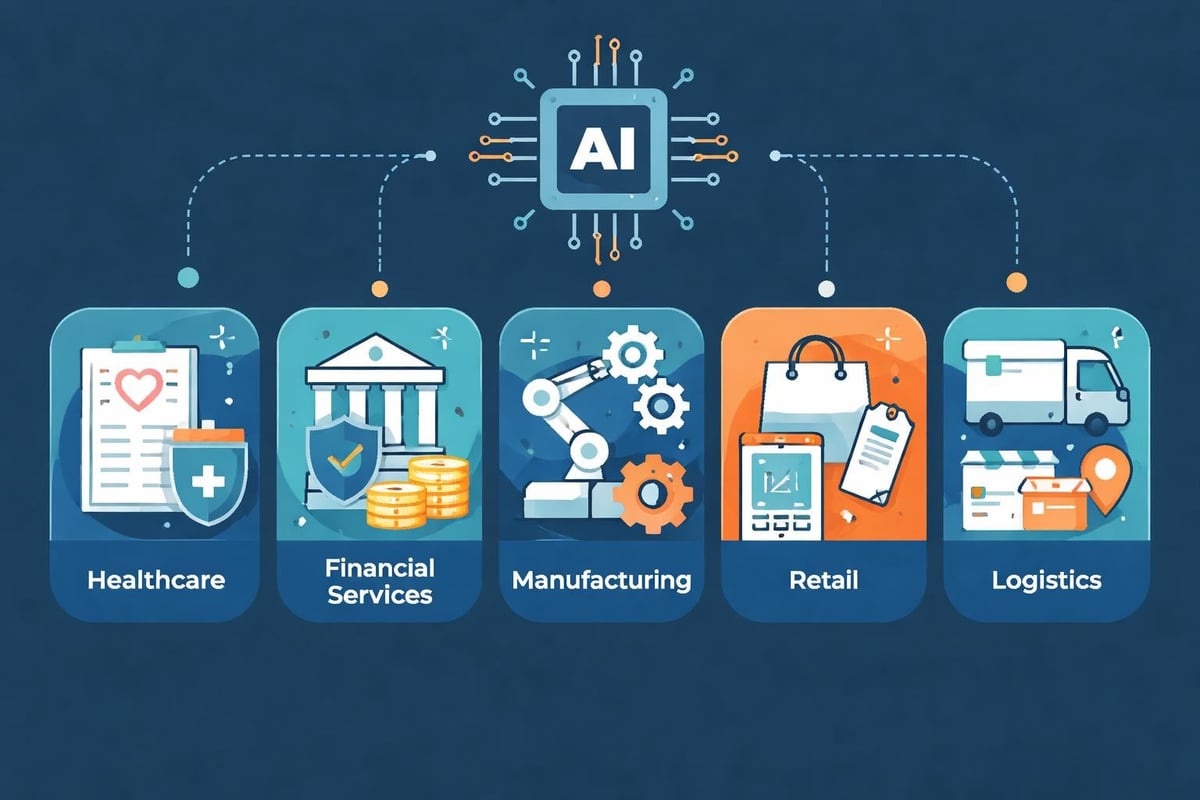
Retail and E-commerce
Customer-facing AI includes recommendation engines, dynamic pricing, inventory optimization, and conversational commerce. Success requires expertise in customer data platforms, real-time decisioning, and omnichannel integration.
Integration Challenges and Technical Debt
Modern enterprises operate complex technology ecosystems built over decades. Successfully integrating AI capabilities into these environments represents one of the most significant challenges ai consulting firms face.
Legacy systems often lack the API interfaces, data accessibility, and computational resources that AI applications require. Consultants must design solutions that bridge these gaps without requiring complete infrastructure replacement, which would be cost-prohibitive for most organizations.
Data quality and availability frequently emerge as project bottlenecks. Client data may be siloed across departments, inconsistently formatted, inadequately documented, or simply unavailable in sufficient volume for model training. Addressing these issues consumes substantial consulting resources but cannot be avoided without compromising results.
Technical debt accumulation poses long-term risks when consultants prioritize rapid deployment over architectural soundness. OpenAI's enterprise push through systems integrators highlights how even cutting-edge AI tools require thoughtful implementation to deliver sustainable value.
MLOps and Production Readiness
Moving AI models from development environments to production systems requires specialized DevOps expertise adapted for machine learning workflows. Leading consulting firms invest heavily in MLOps capabilities that ensure reliable, scalable deployments.
Production AI systems need monitoring for model drift, automated retraining pipelines, version control for both code and data, explainability tools for regulatory compliance, and rollback procedures when models underperform. These operational requirements often surprise organizations focused primarily on algorithm development.
Measuring Success and Continuous Improvement
Establishing appropriate success metrics represents a critical early step in any AI consulting engagement. Without clear measurement frameworks, organizations cannot assess whether investments deliver promised returns or determine how to optimize deployed systems.
Leading firms work with clients to define metrics across multiple dimensions:
Technical Performance Metrics
- Model accuracy, precision, and recall
- Latency and throughput
- System uptime and reliability
- Data processing efficiency
Business Impact Metrics
- Revenue increase or cost reduction
- Process time savings
- Customer satisfaction improvements
- Error rate reductions
Operational Metrics
- User adoption rates
- Support ticket volume
- Training completion
- Knowledge transfer effectiveness
These metrics should be established before project kickoff and tracked throughout the engagement lifecycle. Current industry statistics show that organizations with well-defined success criteria achieve significantly higher ROI from AI initiatives.
Continuous improvement processes ensure AI systems remain valuable as business conditions evolve. Consultants should establish feedback loops that capture user input, monitor performance degradation, and trigger model updates when necessary. This ongoing optimization often provides more value than initial deployment.
Emerging Trends Shaping the Consulting Landscape
The AI consulting industry continues to evolve rapidly as both technology capabilities and client sophistication advance. Several trends are reshaping how ai consulting firms operate and deliver value.
Generative AI Integration
Large language models and generative AI tools have created entirely new consulting opportunities around content creation, code generation, customer service automation, and creative applications. Firms that quickly developed expertise in prompt engineering, fine-tuning, and responsible AI deployment have gained competitive advantages.
Vertical Specialization
Rather than attempting to serve all industries, many consultancies now focus on specific sectors where they can develop deep domain expertise. This specialization enables more efficient engagements and better results, as consultants understand industry-specific data, regulations, and use cases.
Talent Verification and Quality Control
As demand for AI expertise has exploded, the market has seen an influx of consultants with questionable credentials. Organizations increasingly seek verified talent with demonstrable skills rather than impressive resumes that may not reflect actual capabilities. Solutions like Augmnt ATS help companies validate AI professional credentials through comprehensive fraud detection and skill verification before making hiring decisions.
Embedded AI Consultants
Some organizations prefer embedding consultants within internal teams rather than maintaining traditional consultant-client boundaries. This integration approach accelerates knowledge transfer and ensures solutions align closely with organizational culture and processes.
Partnership Ecosystems and Technology Alliances
Major ai consulting firms have established formal partnerships with technology providers to enhance their service offerings and accelerate implementation timelines. These alliances benefit clients through access to pre-built solutions, preferential pricing, and combined expertise.
Cloud platform partnerships with AWS, Microsoft Azure, and Google Cloud provide consultants with infrastructure credits, technical support, and early access to new AI services. These relationships enable more cost-effective projects and reduce deployment complexity.
AI tool vendor partnerships create opportunities for specialized implementations. As noted by industry observers, major consultancies are positioning themselves as key implementation partners for enterprise AI adoption across various platforms.
Industry associations and research collaborations keep consulting firms at the forefront of AI advancement. Participation in academic partnerships, open-source communities, and standards organizations ensures consultants can offer clients cutting-edge capabilities while maintaining ethical and responsible AI practices.
Risk Management and Ethical Considerations
Responsible AI consulting extends beyond technical implementation to address potential risks, ethical implications, and societal impacts of deployed systems. Leading firms integrate these considerations throughout the project lifecycle rather than treating them as afterthoughts.
Bias Detection and Mitigation
AI models can perpetuate or amplify biases present in training data, leading to discriminatory outcomes. Consultants should implement bias testing, diverse dataset curation, and fairness metrics that identify and address these issues before production deployment.
Privacy and Security
AI systems often process sensitive personal or proprietary information, creating privacy risks and security vulnerabilities. Proper data handling, encryption, access controls, and compliance with regulations like GDPR and CCPA are non-negotiable consulting deliverables.
Transparency and Explainability
Many AI applications require the ability to explain how decisions are made, particularly in regulated industries like healthcare and finance. Consultants should implement interpretability tools and documentation that make model behavior understandable to non-technical stakeholders.
Governance Frameworks
Establishing AI governance structures helps organizations manage risks systematically as they scale AI adoption. Consultants should help clients create policies, review processes, and accountability mechanisms that ensure responsible AI use across the enterprise.
The Future of AI Consulting
Looking ahead, ai consulting firms face both tremendous opportunities and significant challenges as the industry continues to mature. Client expectations are rising as AI knowledge becomes more widespread, requiring consultants to deliver increasingly sophisticated solutions.
Automation of routine consulting tasks through AI itself represents an interesting paradox. Tools that automate data analysis, generate code, and optimize models reduce the manual effort required for basic implementations, potentially commoditizing entry-level consulting services while creating demand for higher-value strategic advisory work.
The consulting model itself may evolve toward platforms and products rather than purely services. Some firms are developing proprietary AI tools and frameworks that combine software licensing with implementation services, creating recurring revenue streams and scaling beyond traditional billable hours.
Regulatory developments around AI governance, data privacy, and algorithmic accountability will create new consulting demand while potentially constraining certain applications. Firms that develop expertise in compliance and responsible AI stand to benefit as regulations expand.
For organizations seeking to explore these opportunities, understanding where to find and how to evaluate AI consulting partners becomes increasingly important. Resources like the Augmnt blog provide insights into AI talent trends and implementation best practices that inform better consulting relationships.
AI consulting firms have become essential partners for organizations navigating digital transformation in 2026, offering the specialized expertise needed to translate AI potential into measurable business value. Success requires carefully selecting partners with relevant technical skills, industry knowledge, and proven implementation track records while establishing clear metrics and governance frameworks. When you're ready to build internal AI capabilities with verified professionals who can complement or reduce dependency on external consultants, Augmnt connects you with thoroughly vetted AI talent through intelligent matching and comprehensive fraud detection that ensures you hire qualified experts who can drive your AI initiatives forward.